Use cases Ghost kitchens
Five brands. One kitchen. Your own app.
Upzaar puts all your virtual brands on a storefront website and an ordering app under your name. Keep the delivery apps for discovery. Take your regulars' orders yourself.
100 orders a day × $30 an order × 25% commission
$22,500
a month to the delivery apps, on $90,000 of sales
Example numbers, not a promise. Move 15% of those orders to your own app and the estimate is $2,606 a month kept, after Upzaar and before your own delivery and marketing. Use your own ↓
You cook it. An app sells it.
A ghost kitchen is a strange business to explain to anyone outside it. You have the kitchen, the cooks, the menus and several brands that customers know by name. What you do not have is the shop door. Every order you cook was placed in an app that belongs to someone else.
That app is good at one thing you need: putting your brands in front of strangers. It is also where your regulars order, the ones who would have found you anyway, and you pay the same commission on them.
An own channel does not replace the first job. It takes the second one back. A link on the bag, an app with your name, and the customer’s next order can come to you directly.
30% is the published top-plan commission; ads and promotions are extra, lower plans exist, and a business your size may have agreed its own rate. Sources: Uber Eats merchant pricing, Restaurant Dive on DoorDash’s plans .
Your kitchen, in Upzaar's words.
Upzaar is built as a marketplace: one operator, many sellers. A ghost kitchen fits that shape almost exactly.
-
You haveYour company
In Upzaar it isThe marketplace
One name, one storefront website, one customer app, one admin portal. You are its operator.
-
You haveA virtual brand
In Upzaar it isA seller
Its own name, logo, menu, opening hours and pause switch. One form adds one. Give each the kitchen's address.
-
You haveThe tablet on the pass
In Upzaar it isThe vendor app
It shows one brand at a time, so plan a device per brand.
-
You haveYour riders
In Upzaar it isDrivers, in the driver app
Or no drivers at all: pickup only.
In Upzaar’s words, what you run is a marketplace, even when every seller in it is yours. See the admin portal →
Every brand you cook, in one place.
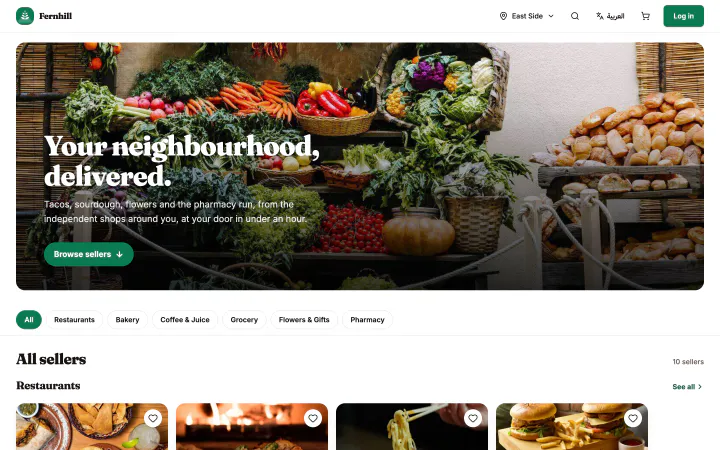
Your customers open one storefront or one app and see all your brands, each with its own page and menu. It is your name on the icon, not an aggregator's.
- One search across every brand and dishA customer who types burger finds it whichever of your brands sells it.
- Group brands by categoryEach brand sits under one category you name, shown as chips on the home screen.
- Guests can orderNo account needed on the website or in the app.
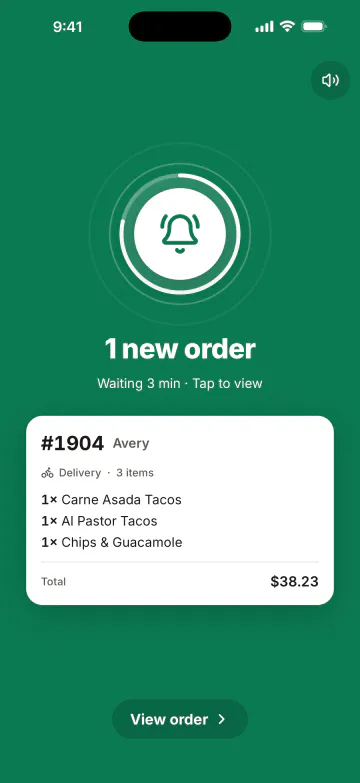
A new order takes over the screen.
Each brand's orders arrive in the vendor app with a full-screen alert that rings. The cook accepts with a prep time, and the customer sees it.
- Accept with a prep time10, 15, 20, 30 or 45 minutes, or reject with a reason the customer is shown.
- Sold out in one switchA sold-out item can no longer be added to a cart.
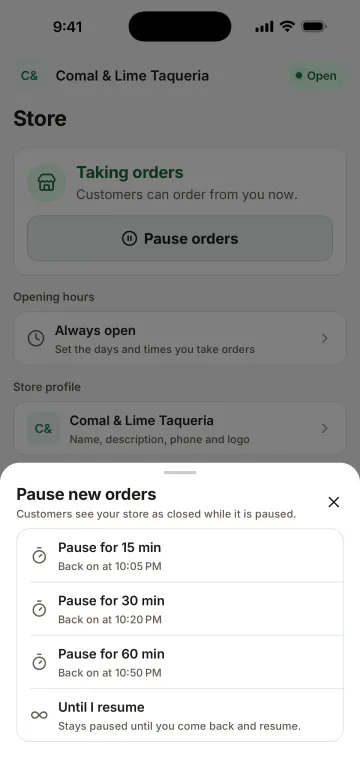
- Pause one brand, keep the rest openFor 15, 30 or 60 minutes, or until you resume. The pause ends by itself.
Good to knowThe alert keeps ringing only while the app is open; closed, it is one push with a sound. The app shows one brand at a time, and it is not a kitchen display system.
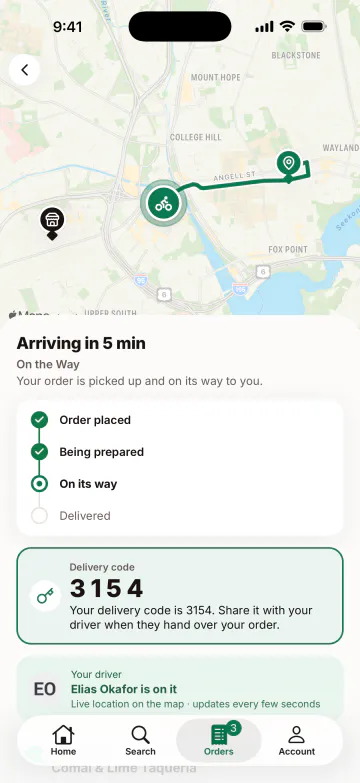
Your drivers, your zones, or pickup.
Draw the zones you deliver to and give each a fee and a delivery time. Your own drivers take the jobs in the driver app, and customers follow them live in the customer app.
- Zones with their own priceRectangles on a map, each with a fee and a time. Outside them: a fixed fallback fee, or refuse.
- Offered to your drivers, first to acceptEach job goes to every active driver assigned to that area.
- Or pickupOrder ahead and collect at your door. No driver, no delivery fee.
Good to knowA driver takes one job at a time, so two brands' orders for the same address are two jobs. Jobs are offered, not assigned by you.
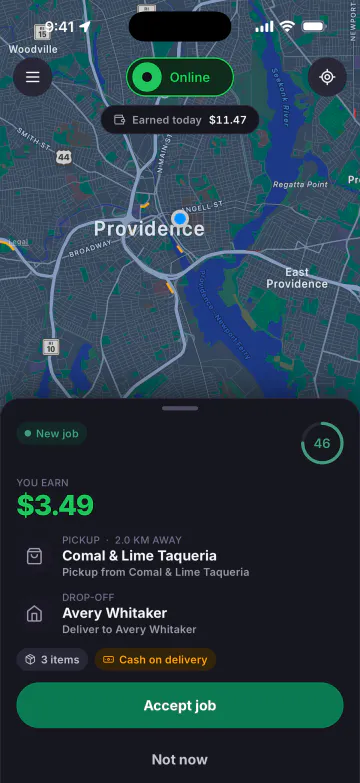
The screens above are real screens of the product on Fernhill, our demo marketplace of local food and shops. Yours carries your name, your colors and your sellers.
What do your regulars cost you on the apps?
Four numbers you already know. The answer is what the orders you move cost on the aggregator, and what the same orders cost on a channel you own.
Estimate
The difference, a month
An estimate, not a promise$2,606
450 of your 3,000 orders, placed on your own channel instead: $3,375 in aggregator commission against $769 to Upzaar.
At these numbers your own channel costs more than it saves. It needs more orders moved, or a smaller plan.
Not in this number, because we cannot know it: Your own delivery: a top aggregator plan usually includes their drivers, and on your own channel the drivers are yours, or it is pickup. What it costs to get customers to order direct: bag flyers, a first-order discount, your social accounts. Your time.
Your numbers
This is a worked example with the numbers below. With JavaScript on, you can change every one of them.
The orders you move, a month
- Orders moved (15% of 3,000)
- 450
- Their order volume, at $30.00 an order
- $13,500
- On the aggregator, at 25%
- $3,375
- Upzaar Growth plan
- −$499
- Upzaar platform fee, 2% of that volume
- −$270
- The difference
- $2,606
The whole month
Where it starts to pay: the Growth plan is covered at 73 orders a month on your own channel (2.4% of your orders). Each one is worth $6.90 to you before the plan’s price. the Growth plan would need 73 orders a month on your own channel, more than you have in total. Try a smaller plan. it does not, at this rate: an order on your own channel brings in no more than Upzaar’s platform fee takes.
How this is calculated, and how to read it
How this is calculated
Read it honestly
- The share is the guessIt starts at 15% on purpose. The aggregator still brings people who have never heard of you; your own channel is for the ones who have. Nobody can promise you a share.
- Upzaar’s cost is all of itThe plan ($79, $499, $1,499 a month) plus 2% of the order volume on your channel. Nothing else from us.
- No card fees to modelOrders on Upzaar are paid in cash, on delivery or at pickup. Card payments are not in the product today.
Want the split of a single order instead? Marketplace commission calculator →
What it does not do yet.
You run a real operation, so here is the list before you ask. None of these is in the product today. For each, what you would do instead.
- Aggregator orders on the same screen
- There is no integration with any delivery app. Their tablets stay on the pass next to your own. Orders from your channel arrive in the vendor app; theirs arrive where they do today.
- One basket across brands
- A cart holds one seller, so one brand. Two brands in one sitting is two orders, two delivery fees and two delivery jobs. If customers mix often, sell the combination as one brand's menu.
- One kitchen screen for every brand
- A staff account belongs to one seller and the vendor app shows one at a time: plan a signed-in tablet per brand. It is not a kitchen display system. It does not route items to stations and it does not print.
- A link to your POS or stock system
- None, and there is no public API or webhook to build one on. Menus and prices are kept in Upzaar; stock is a sold-out switch per item, not a count.
- Scheduled orders
- Orders are for now. There is no order-for-later and no reorder in one tap.
- Card payments
- Customers pay in cash, on delivery or at pickup. There is no card or online payment in the product today, so there is no card fee and no automatic payout either.
The plan that fits
Growth
$499 /mo + 2% of orders
Or $399/mo billed annually. Up to 50 sellers.
Your own customer app and vendor app, built by our team under your name, with the driver app for up to 5 drivers. Room for 50 sellers, so 50 brands.
- Starter, $79
- The storefront website and the admin portal only. Enough to test demand with pickup, but there is no vendor app, so the kitchen gets no ringing alert.
- Scale, $1,499
- When you run more than 5 drivers of your own. The driver cap comes off.
Start with the brands you already cook.
- 1Tell us how many brands and kitchens you run, and who delivers today. We reply by email.
- 2Add each brand as a seller: name, logo, the kitchen's address, its menu with options and add-ons.
- 3Set your commission to 0% for your own brands. Draw your delivery zones, or switch on pickup.
- 4Invite your kitchen staff, one sign-in per brand, and your drivers.
- 5Put the link on every bag. The customers you already serve are the ones who will use it.
Plans are set up by people: there is no checkout, our team sets you up and bills you directly. The seller and driver counts are the terms of each plan. Our team builds your native apps and sends them to the app stores, on iOS and Android.
Questions.
Can a customer order from two of my brands in one basket?
No. A cart belongs to one seller, and each of your brands is a seller. A customer can keep a cart open at several brands at once, but each is checked out on its own and becomes its own order, with its own delivery fee and its own delivery job.
Does this replace the delivery apps?
No, and it should not be planned that way. The aggregators bring people who have never heard of you. Your own channel is for the people who have: regulars, and anyone holding one of your bags. The calculator on this page starts with a small share of orders moved for that reason.
Does it connect to my POS, or to the aggregators' tablets?
No. Upzaar has no POS integration, no link to any delivery app, and no public API or webhooks. Orders from your own channel arrive in Upzaar's vendor app.
What do I pay Upzaar?
A monthly plan ($79, $499 or $1,499) plus a platform fee of 2% of the order volume on your marketplace, on every plan. The commission you charge sellers is yours to set and keep. On your own brands you would set it to 0%.
Who delivers?
You do, or the customer picks up. Upzaar does not supply drivers. Your own drivers use the driver app (up to 5 drivers on Growth, no cap on Scale): each job is offered to every active driver assigned to that area and the first to accept takes it.
How do customers pay?
In cash, on delivery or at pickup. There is no card or online payment in the product today. A ledger tracks the cash each driver holds and the deposits you record.
Can I host other people's brands and charge them?
Yes. Add the brand as a seller with its own commission rate. The commissions report shows that seller's sales, your commission and the payout due. Upzaar does not move the money: you settle with them yourself.
Other businesses that already take orders.
-
You have the drivers
Restaurant groups with their own drivers
You already pay the drivers. Get the ordering app and the driver app that go with them, with every location inside.- Each location is a seller, with its own menu and hours.
- Driver app, live tracking, cash ledger, cash limits.
- Jobs are offered, not assigned. No POS link.
-
You have the fleet
Delivery companies
You deliver the order today. Take the order too, and earn the commission as well as the fee.- A merchant you deliver for is a seller.
- Driver app, cash ledger, cash limits, delivery code.
- Jobs are offered, not assigned. No batching, no outside jobs.
-
Many outlets, your name
Multi-brand operators
One app and one storefront for the whole group, with every brand and outlet inside.- Each outlet is a seller, with its own menu and hours.
- Head office sees every outlet's orders and sales.
- The customer picks the outlet. No loyalty, no POS link.
Starting from zero, with no orders yet? That is a different page: the marketplace ideas directory →
Your brands are already cooking. Give them a front door.
Tell us what you run today: how many brands and kitchens, roughly how many orders, who delivers. We reply by email with what fits, what does not, and a plan.
Opens our contact form with a first line filled in. Rather talk first? Book a demo.