Use cases Restaurant groups with their own drivers
Your drivers. Your app. Your customers.
You already hire, schedule and pay the people who carry your food. Upzaar gives the group the rest: a storefront website and native apps under your name, every location inside, and a driver app your drivers use for every job.
- Every location
- A driver app
- 0% commission on your stores
150 orders a day × $30 an order × 30% commission
$40,500
a month to the delivery apps, on $135,000 of sales
Example numbers, not a promise. Move 15% of those orders to your own app and the estimate is $4,171 a month kept, after Upzaar and before your own delivery and marketing. Use your own ↓
You run the drivers. Someone else runs the order.
A group that runs its own drivers has already solved the expensive half of delivery. You hire them, you schedule them, you know which store runs short on a Friday night, and your customers know the driver by the car.
The ordering is often somebody else’s. On a delivery app the order is placed in the app’s name, with a commission on it, and the customer is theirs to bring back. Or the orders come in through an ordering tool, and the drivers who carry them are run from a group chat and a whiteboard.
Upzaar puts the two halves together. Every location is a seller in one marketplace under your name, and the driver app is part of the same order: the store accepts it, a driver takes the job, the customer watches the driver come, and the cash comes back on a ledger.
If you are weighing an online ordering platform for restaurants against this, we compared the common ones honestly, including where each is the better pick: Upzaar compared.
30% is the published top-plan commission; ads and promotions are extra, lower plans exist, and a business your size may have agreed its own rate. Sources: Uber Eats merchant pricing, Restaurant Dive on DoorDash’s plans .
-
Who takes the cut
On the delivery apps, a commission on every order placed there, including the ones your own drivers carry.
-
Who owns the customer
The app the order was placed in. The next order is placed there too.
-
On a channel you own
The order, the store that cooks it, the driver who carries it and the cash they bring back, in one place under your name.
Your group and your drivers, in Upzaar's words.
Upzaar is built as a marketplace: one operator, many sellers, one fleet of drivers. Head office is the operator, each location is a seller, and your drivers are the marketplace's drivers.
-
You haveThe group
In Upzaar it isThe marketplace
One name, one storefront website, one customer app, one admin portal.
-
You haveEach location
In Upzaar it isA seller
Its own address, menu, opening hours and vendor app. A brand with six locations is six sellers.
-
You haveYour drivers
In Upzaar it isDrivers
Invited by email and assigned to areas. Each job is offered to the drivers of the area, and the first to accept takes it.
-
You haveYour delivery radius
In Upzaar it isDelivery zones
Rectangles on the map, each with its own delivery fee and delivery time, grouped into areas.
-
You haveCash at the door
In Upzaar it isA cash ledger per driver
Cash collected, and the deposits and payouts you record. Upzaar never holds or moves the money.
In Upzaar’s words, what you run is a marketplace, even when every seller in it is yours. See the admin portal →
A driver app for the drivers you already have.
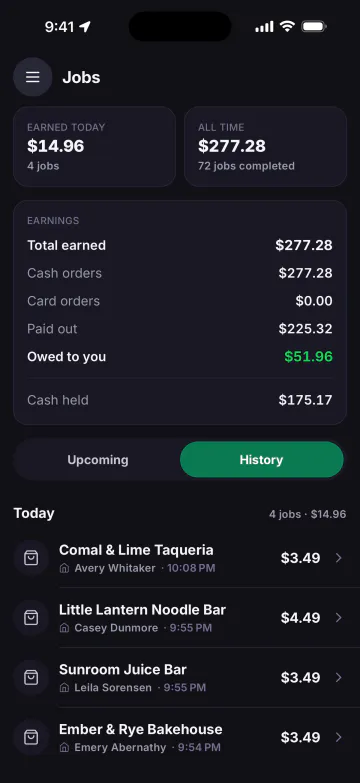
Each delivery is a job in the driver app: what it pays, where to collect, where to drop, and whether there is cash to take. Accept, pick up, deliver: one button each.
- Offered by area, first to acceptEvery active driver assigned to the order's area gets the offer, with a 60-second countdown. A skipped offer waits in a list.
- A delivery code at the door, if you want oneFour digits the customer reads out. Five wrong codes lock the delivery until your staff unlock it.
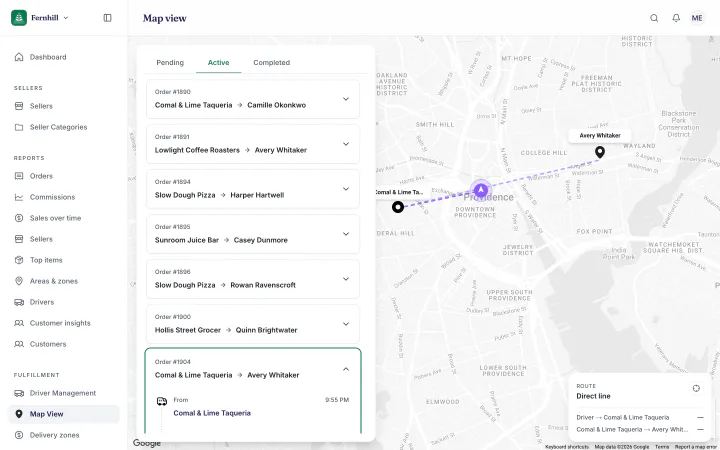
- Navigate hands off to Apple Maps or Google MapsThe driver's position is sent about every 10 seconds while online, for the customer, the store and your map.
Good to knowOffers appear while the driver app is open on screen: a new offer has no push and no sound. Drivers keep the app open on shift.
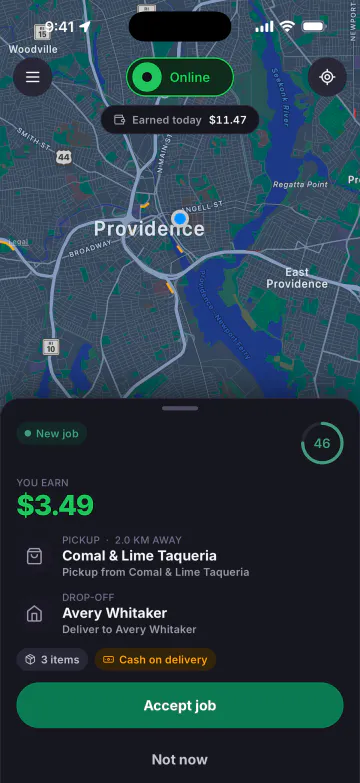
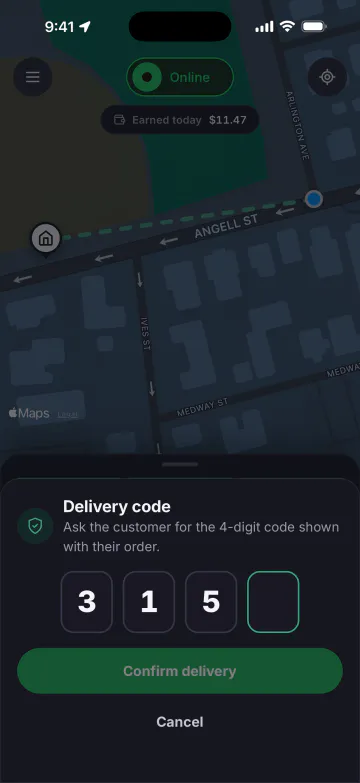
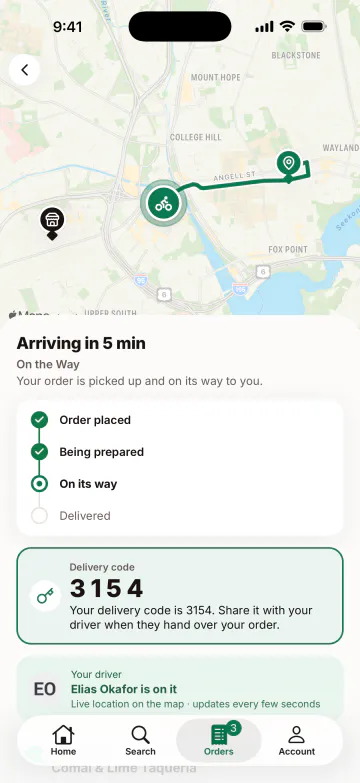
Your driver, on their map.
In the customer app, a delivery shows the driver on a map with their name and photo, from pickup to the door. The app carries your group's name on the icon.
- The address comes firstA shopper drops a pin and sees which of your locations deliver there, the delivery fee and the delivery time, before ordering.
- Native apps under your nameBuilt by our team and published on the App Store and Google Play with your own listings.
- Guests can orderA name and a phone number at checkout, no account needed.
Good to knowThe live map is in the customer app. The storefront website's order page shows the status as of the last load.
Every driver's cash, on one ledger.
Each delivery is recorded against the driver who made it: the fee earned and the cash collected. You record the deposits and the payouts. Upzaar never holds or moves the money.
- Cash held, per driverCash collected, deposits and payouts you record, and voids with a reason.
- A cash limitFor the whole fleet or per driver. Past it, a driver is offered no more cash orders until a deposit is recorded.
- The delivery fee pays the deliverySet per zone. On a job your drivers carry, the fee is the group's: it is never commissioned and never counted in a store's sales.
Good to knowIn the ledger a driver earns the delivery fee of each job. What you actually pay your drivers, by the hour or by the drop, is between you and them, and you record it.
Every store runs its own shift.
Each location has the vendor app: a new order takes over the screen and rings, the manager accepts with a prep time and marks it ready, and the job goes to your drivers. Head office sees every store in the admin portal.
- 0% commission on your own storesThe commission rate is for hosted brands or franchisees. On the stores you own, leave it at zero.
- Zones with their own fee and timeDraw each store's delivery zones, set a fee and a delivery time on each, and switch a zone off on a short-staffed night.
- Sales by storeThe sellers report ranks every location by sales, orders, average order and cancellation rate, against the period before. CSV export.
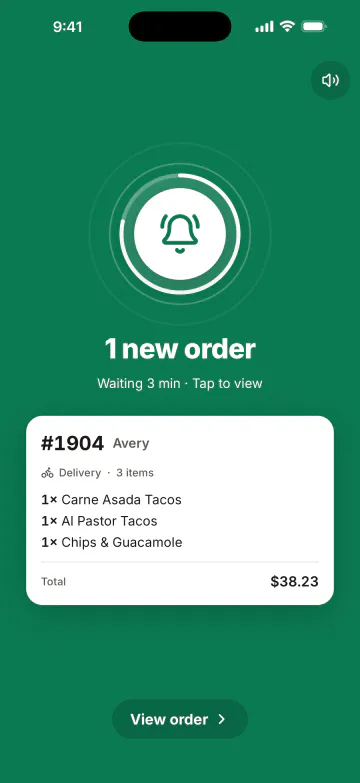
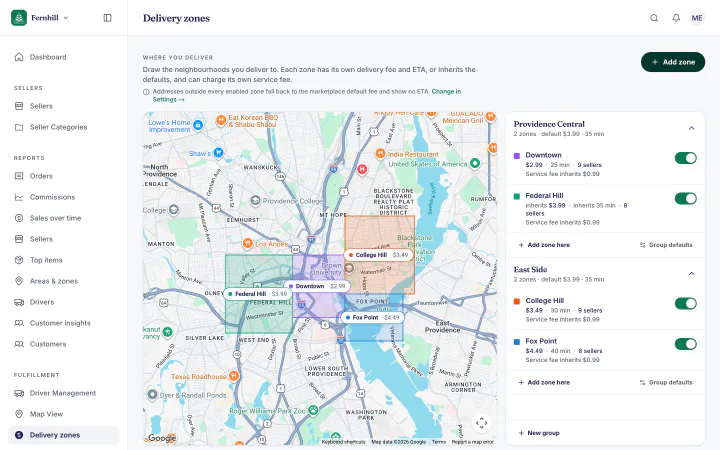
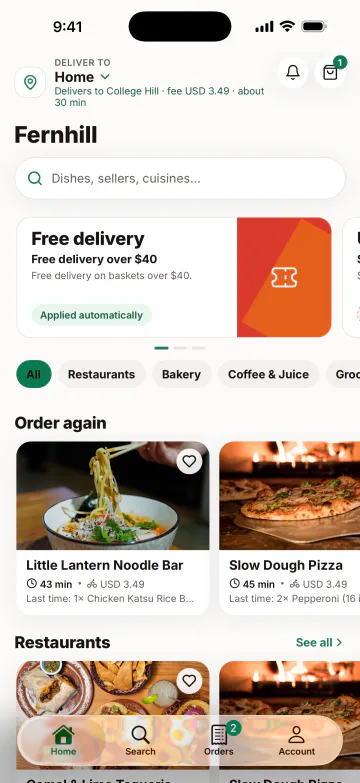
The screens above are real screens of the product on Fernhill, our demo marketplace of local food and shops. Yours carries your name, your colors and your sellers.
What do the apps take on your regulars?
Four numbers head office already has. The answer is what the orders you move cost on the aggregator, and what the same orders cost in an app you own.
Estimate
The difference, a month
An estimate, not a promise$4,171
675 of your 4,500 orders, placed on your own channel instead: $6,075 in aggregator commission against $1,904 to Upzaar.
At these numbers your own channel costs more than it saves. It needs more orders moved, or a smaller plan.
Not in this number, because we cannot know it: Your drivers: you pay them today and you will pay them then. In your own app the delivery fee per zone is the group's and goes toward them. What it costs to move customers into your app: a card in every bag, a first-order discount, a flyer your drivers hand over at the door. Orders you take by phone or on another ordering tool today, which this does not count.
Your numbers
This is a worked example with the numbers below. With JavaScript on, you can change every one of them.
The orders you move, a month
- Orders moved (15% of 4,500)
- 675
- Their order volume, at $30.00 an order
- $20,250
- On the aggregator, at 30%
- $6,075
- Upzaar Scale plan
- −$1,499
- Upzaar platform fee, 2% of that volume
- −$405
- The difference
- $4,171
The whole month
Where it starts to pay: the Scale plan is covered at 179 orders a month on your own channel (4% of your orders). Each one is worth $8.40 to you before the plan’s price. the Scale plan would need 179 orders a month on your own channel, more than you have in total. Try a smaller plan. it does not, at this rate: an order on your own channel brings in no more than Upzaar’s platform fee takes.
How this is calculated, and how to read it
How this is calculated
Read it honestly
- The share is the guessIt starts at 15% on purpose. The aggregator still brings people who have never heard of you; your own channel is for the ones who have. Nobody can promise you a share.
- Upzaar’s cost is all of itThe plan ($79, $499, $1,499 a month) plus 2% of the order volume on your channel. Nothing else from us.
- No card fees to modelOrders on Upzaar are paid in cash, on delivery or at pickup. Card payments are not in the product today.
Want the split of a single order instead? Marketplace commission calculator →
What it does not do yet.
You run a real operation, so here is the list before you ask. None of these is in the product today. For each, what you would do instead.
- Assigning a job to a driver, or batching two orders
- Nobody can assign. Each job is offered to every active driver of the area, and the first to accept takes it. The driver app handles one job at a time, so two orders to the same street are two jobs. Your staff can complete an order by hand.
- Route planning or in-app navigation
- Navigate opens Apple Maps or Google Maps for the next stop. There is no route optimization.
- A link to your POS (Square, Toast and the like)
- None today, and there is no public API or webhook. Orders arrive in each store's vendor app, and reports export to CSV.
- Sending overflow to a third-party delivery network
- Not in the product today. A delivery order goes to your drivers. When a store is short of drivers, switch it to pickup only, or pause it for 15, 30 or 60 minutes.
- A tip for the driver at checkout
- Not in the product today: there is no tip line at checkout. In the ledger, a driver's earning for a job is the zone's delivery fee.
- Orders for later: catering, scheduled delivery
- Not built. An order is placed for now. Take catering and scheduled orders the way you do today.
- Sending the order to the nearest store
- The customer picks the store. The customer app shows the stores linked to the zone the address is in; the website lists every store. Name stores by neighborhood so the choice is obvious.
- Card payments
- Customers pay in cash, on delivery or at pickup. There is no card or online payment in the product today, so there is no card fee and no automatic payout either.
The plan that fits
Scale
$1,499 /mo + 2% of orders
Or $1,199/mo billed annually. Up to 200 sellers.
A group with its own fleet runs more than five drivers, and Scale has no driver cap. It includes the customer app, the vendor app and the driver app, built by our team under your group's name, with room for 200 locations.
- Growth, $499
- The same apps, with the driver app for up to 5 drivers and 50 sellers. Enough to pilot one or two stores.
- Enterprise
- More than 200 locations, or work that is not in the product. Custom pricing, scoped with our team: talk to us.
Start with one store and its drivers.
- 1Tell us how many locations and drivers you run, and how you take orders today. We reply by email.
- 2Add each location as a seller, with its address, menu and opening hours.
- 3Draw each store's delivery zones, set the fee and time for each, and group them into one area per store.
- 4Invite that store's drivers to the driver app, assign them to its area, and set a cash limit.
- 5Tell the customers you already have: a card in every bag, the receipt, the box, your social accounts.
Plans are set up by people: there is no checkout, our team sets you up and bills you directly. The seller and driver counts are the terms of each plan. Our team builds your native apps and sends them to the app stores, on iOS and Android.
Questions.
Do we have to leave the delivery apps?
No. Keep them: they bring you people who have never heard of you. Your own app is for the customers who already know your name and order every week. That is why the calculator above starts with a small share.
Can each store have its own drivers?
Yes, through areas. Drivers are assigned to areas, and an area is a group of delivery zones. Group each store's zones into an area of its own and assign that store's drivers to it: they are offered the deliveries whose address falls in that area. A driver can be assigned to more than one area.
Can a manager assign a delivery to a specific driver?
No. Jobs are offered to every active driver assigned to the order's area, and the first to accept takes it. There is no manual assignment, reassignment or batching. A Dispatcher role sees the delivery map, manages zones and can complete an order by hand.
Do customers see where the driver is?
In the customer app, yes: the driver's name, photo and position on a map, for the length of the delivery. The storefront website's order page shows the status as of the last load and does not update by itself.
How is cash on delivery handled?
The driver collects the order total in cash. The ledger shows the cash each driver holds; you record a deposit when they hand it in. With a cash limit set, a driver is offered no more cash orders until a deposit is recorded.
What do drivers earn, and can customers tip?
In the ledger, a driver earns the delivery fee of each job they complete, also when a discount made delivery free for the customer. What you actually pay your drivers is between you and them, and you record the payouts. There is no tip at checkout in the product today.
How do customers pay?
In cash, on delivery or at pickup. There is no card or online payment in the product today. On the Enterprise plan a card payment integration can be scoped as custom work with our team; it is not something you can switch on.
Which plan fits a group with its own drivers?
Scale ($1,499 a month plus 2% of order volume) once you run more than five drivers: it has no driver cap and room for 200 locations. Growth ($499 plus 2%) includes the driver app for up to 5 drivers, which is enough to pilot one or two stores.
Other businesses that already take orders.
-
One kitchen, many brands
Ghost kitchens
Every virtual brand you cook, on one storefront and one app with your name on it.- A virtual brand is a seller. One form adds one.
- Your commission on your own brands: 0%.
- One cart per brand. No aggregator or POS link.
-
You have the fleet
Delivery companies
You deliver the order today. Take the order too, and earn the commission as well as the fee.- A merchant you deliver for is a seller.
- Driver app, cash ledger, cash limits, delivery code.
- Jobs are offered, not assigned. No batching, no outside jobs.
-
Many outlets, your name
Multi-brand operators
One app and one storefront for the whole group, with every brand and outlet inside.- Each outlet is a seller, with its own menu and hours.
- Head office sees every outlet's orders and sales.
- The customer picks the outlet. No loyalty, no POS link.
Starting from zero, with no orders yet? That is a different page: the marketplace ideas directory →
You already pay the drivers. Own the order they carry.
Tell us what you run today: how many locations and drivers, roughly how many orders, who delivers. We reply by email with what fits, what does not, and a plan.
Opens our contact form with a first line filled in. Rather talk first? Book a demo.