Marketplace ideas Services · Bookings
StudyStoop
Local tutors, one booking page.
They teach. You fill their calendar, and earn a cut of the lessons you bring.
- An idea. Not a company. Yet.
Fund it Our verdict on Pitch Night. Why ↓
- Bookings a day
- 25
- Average booking
- $35
- You earn, a month
- $2,925
An estimate from illustrative numbers (the “growing” stage), not a promise. Change every one of them ↓
The best tutor in town is found by asking around.
More than 215,000 people worked as tutors in the US in 2024, and their median pay in 2025 was under $21 an hour. Good at teaching, most of them, and not paid like it.
Meanwhile parents find tutors the way they always have: by asking around. There is no single place that shows who teaches what in your town, who is free on Tuesdays, and what a lesson costs.
So: they teach, you fill the calendar. The verdict was fund it, with a warning. After the first lesson, the parent has the tutor’s number. If rebooking through you is not easier than a text message, you earned one commission and lost a customer. Build for the second lesson.
- 215,000+ people worked as tutors in the US Source: O*NET OnLine, 2024
- Under $21 an hour: the median pay of a tutor Source: O*NET OnLine, 2025
Fund it
The Pitch Night verdict
If rebooking through you beats a text message.
- Demand
- Supply
- Margin
The hard question: After lesson one, why pay you?
Who sells. Who buys.
Your sellers
Independent tutors: teachers earning on the side, graduate students, retired teachers, music and language teachers. They are good at teaching and find students by word of mouth, a card on a noticeboard, or an agency that takes its own share of the fee.
Where to find the first ten
- 1Start with one subject and one age group. Maths for ages 11 to 16 is a market by itself.
- 2Ask school parent groups who they already use. The names repeat.
- 3Talk to graduate students in the nearest university's maths and science departments.
- 4Find tutors working through an agency. They know what a cut feels like.
- 5Meet every tutor in person before you list them. Parents will ask if you did.
Your buyers
Parents, mostly. An exam is coming, a grade has slipped, and they want someone local they can trust, without a month of asking around.
How often they come back
Weekly, for a term or a school year. A student who stays is worth dozens of lessons, which is exactly why the hard question matters.
How you get paid.
-
Commission
Median tutor pay is under $21 an hour, so there is little room for a big cut. Earn a modest rate on every lesson, and make staying on the platform easier than leaving it.
On Upzaar: one rate for the marketplace, with an override per seller. Not per category.
-
Service fee
A small booking fee paid by the parent, per lesson or per pack.
On Upzaar: one flat fee per order, paid by the customer. The marketplace keeps it.
Know this before you start: orders are paid in cash today.
The customer pays the seller in person. Card payments are not live yet. That means the seller holds the money and owes you your commission and fee: the commissions report shows what each seller sold and what is yours. Plan a weekly settlement, and sign sellers who are fine with that.
What could StudyStoop earn you?
Prefilled with our starting assumptions for this idea. Every number is yours to change, and the formula is at the bottom.
Estimate
You earn, per month
An estimate, not a promise$2,925
Before your costs. 12.9% of the order volume.
- Commission
- $2,275
- Service fees
- $650
Change the numbers
- Bookings per day
- 25
- Average booking value
- $35.00
- Your commission
- 10%
- Your service fee per booking
- $1.00
- Days open per month
- 26
This is a worked example. With JavaScript on, you can change every number.
The month
- Bookings
- 650
- Order volume (GMV)
- $22,750
- Your sellers keep
- $20,475
One booking
- The customer pays
- $36.00
- The seller keeps
- $31.50
- You earn
- $4.50
What your sellers pay in commission, per month
$4,550 a month stays with your sellers. 30% is the published top-plan commission; ads, promos and refunds are extra. Sources: Uber Eats merchant pricing, Restaurant Dive on DoorDash’s plans .
Same numbers, three stages
Only the bookings per day change. Pick one to load it.
How this is calculated
- Commission is taken on the booking value only, not on delivery or service fees.
- The currency menu swaps the symbol. There is no exchange rate anywhere.
- Not subtracted: your Upzaar plan and its platform fee on order volume (see pricing), payment processing if you add a card gateway, marketing, and your own time. The break-even calculator takes those off.
- Promotions, refunds and canceled bookings are not modeled. Real months are lumpier than this.
Where the prefilled numbers come from
- Bookings per day (illustrative): Illustrative. 25 lessons a day is fewer than 2 a day for each of 15 tutors.
- Average booking value (illustrative): Illustrative. One lesson. For scale, O*NET puts a tutor's median pay under $21 an hour (2025). A lesson price is not a wage: use your town's going rate.
- Commission (illustrative): Illustrative. Modest, because tutor pay leaves little room.
- Service fee (illustrative): Illustrative booking fee.
- Days open (illustrative): Six days a week.
Illustrative means we picked a plausible starting point and told you why. It is not data about a real marketplace. Replace it with what you learn from your own sellers.
What StudyStoop looks like on Upzaar.
Real screens from Fernhill, our demo marketplace of local food and shops. Yours carries your name, your colors and your sellers. Fernhill sells food, so these screens show food: a service is listed, ordered and accepted the same way. There is no courier in this idea, so there is no driver app here.
-
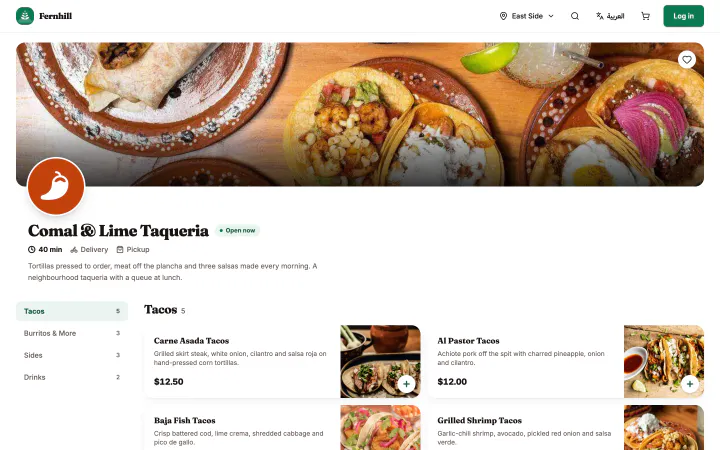
Storefront websiteA seller's page on your storefront. A tutor lists lessons and packs the way this taqueria lists a menu.
-
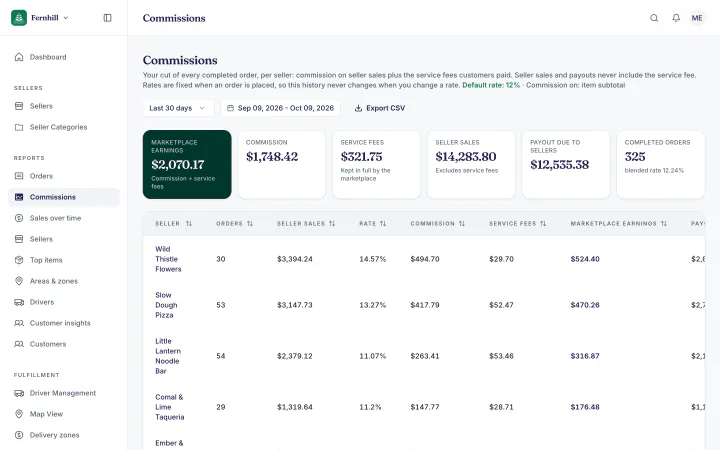
Admin portalThe commissions report: lessons sold per tutor, your cut, the payout due.
-
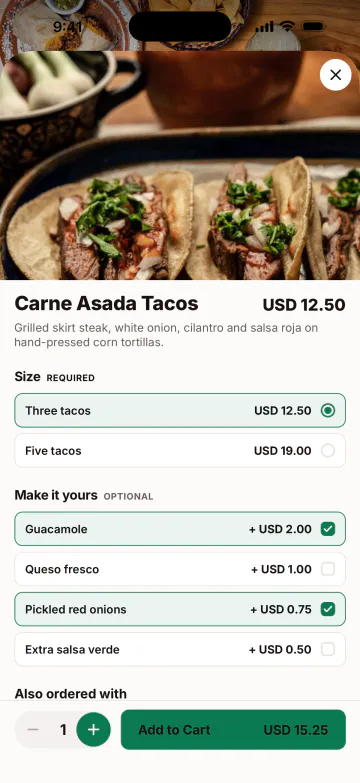
Customer appA lesson with a required choice and paid add-ons: 60 or 90 minutes, add exam papers.
-
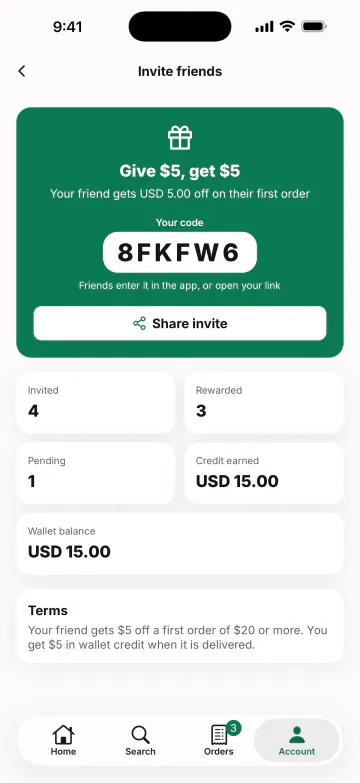
Customer appParents talk at the school gate. A give-and-get code turns that into bookings.
-
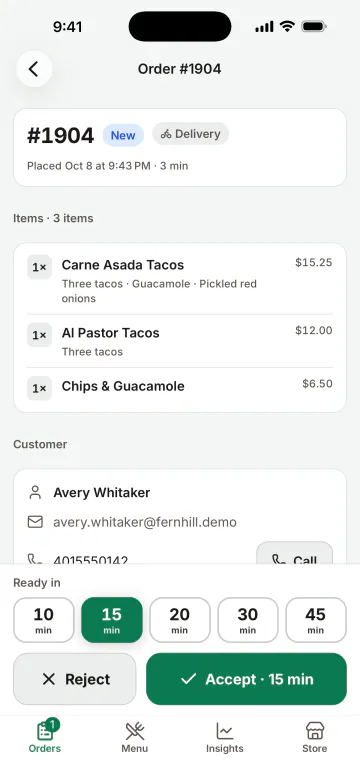
Seller appThe tutor sees the request and the parent's note, and accepts or rejects.
-
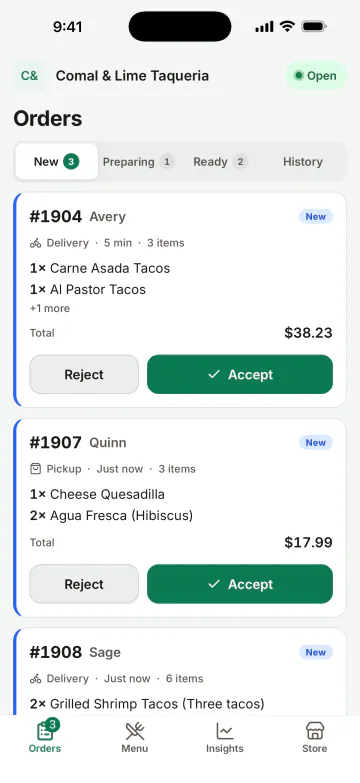
Seller appThe tutor's requests in one list: new, accepted, done.
Not built yet, and what version one does instead
- A bookings calendar that takes payment and commission
- Upzaar has a basic bookings feature: a service with time slots and a capacity that a customer reserves. A reservation carries no price, so no commission comes from it, and the native apps do not take bookings. Version one sells each service as a priced listing instead: the customer orders it for pickup and writes the time they want in the item's special request, the pro accepts in the seller app, and the sale runs through your commission and reports like any order.
- Rebooking the same slot every week
- There are no recurring orders. That is the hard question in product form. Version one sells packs of five or ten lessons as one listing, so the parent pays once and the weekly time is agreed with the tutor.
- Online lessons
- No video classroom is built in. Tutors teach in person or send their own video link.
- Card payments
- Orders are paid in cash today. See “How you get paid” above for how the money moves.
What you would run it on
- The storefront website and the admin portal are in every plan. Enough to prove StudyStoop with your first sellers.
- Your own customer and seller apps in the app stores come with the next plan up.
The StudyStoop launch checklist.
-
Week 1
Choose the subject
- Pick one subject and one age group to own first.
- Ask twenty parents how they found their tutor.
- Tell us what you are building; we set up your storefront.
-
Week 2
Meet fifteen tutors
- Meet each tutor and check their background yourself.
- Agree lesson prices, pack prices and your commission.
- List each tutor with what they teach and where.
-
Week 3
Sell packs
- Make a five-lesson pack the default offer.
- Book three families you know and follow each first lesson.
- Ask why they would or would not rebook through you.
-
Week 4
Open before exams
- Launch through school parent groups with a first-lesson promo code.
- Give every parent a referral code.
- Settle with tutors and count the rebooks.
Read before you start, from Marketplace University
-
Cold Outreach
Where to Find Your First Vendors (Before You Have Any Customers)
You don't need a big audience to land your first vendors — you need the right handful of places to look.
-
Commissions & Pricing
Commission vs. Subscription: Which Pricing Model Fits Your Marketplace?
Take a cut of every sale, or charge vendors a flat fee to participate — the two models solve different problems.
-
Referrals & Word of Mouth
How to Turn Your First Customers Into Your Referral Engine
A new marketplace's first real growth channel usually isn't ads — it's the small group of customers who already like it.
Ideas next door.
-
Services
Bookings
GlowBook
Every independent barber, salon and spa in town, in one place. They cut and style. You fill the empty chairs, and take a small cut of the bookings you bring. You could earn, at 40 bookings a day $5,200 / month -
Services
Bookings
HomeFix
Vetted local plumbers, electricians, cleaners and handymen, booked in one place. They fix it. You take the bookings, vouch for the pros, and earn a cut of each job you send. You could earn, at 8 bookings a day $4,080 / month -
Services
Bookings
MatMeet
Local trainers and yoga teachers, on one schedule. They run the class. You fill the room, by selling packs across every independent teacher in town. You could earn, at 15 bookings a day $3,150 / month
Nobody owns StudyStoop in your city. Yet.
Tell us where you would start. Our team sets up your storefront with you: your name, your sellers, your commission, live in under a week.
Opens our contact form with this idea filled in. Rather talk first? Book a demo.