Marketplace ideas Services · Delivery
HangerHop
Local dry cleaners, picked up at your door.
They clean it. You run the route: one neighborhood, one pickup day, a fee on every order.
- An idea. Not a company. Yet.
Fix one thing Our verdict on Pitch Night. Why ↓
- Orders a day
- 35
- Average order
- $30
- You earn, a month
- $1,568
An estimate from illustrative numbers (the “growing” stage), not a promise. Change every one of them ↓
The dry cleaner closes at six. So does your office.
More than 200,000 people worked in laundry and dry cleaning in the US in 2024. The shops are on every high street, the machines are running, and the counter closes at about the time the customers get out of work.
Supply scored five out of five. The trouble is the trip. Clothes have to get to the cleaner and come back, and nobody can afford two journeys for one shirt. That is why on-demand laundry is hard, and why the delivery apps leave it alone.
So fix one thing. They clean it, you run the route. One neighborhood, one pickup day: every stop on one round, the same day every week. It is less glamorous than on-demand, and it is the version that makes money.
- 200,000+ people worked in laundry and dry cleaning in the US Source: O*NET OnLine, 2024
Fix one thing
The Pitch Night verdict
One neighborhood. One pickup day. Routes, not on-demand trips.
- Demand
- Supply
- Margin
The hard question: Two trips for one shirt?
Who sells. Who buys.
Your sellers
Independent dry cleaners and laundries. The machines are running anyway, and the shop has spare capacity. What they do not have is a van, a driver, or customers who can get there during opening hours.
Where to find the first ten
- 1Start with one cleaner, not ten. One good plant can serve a whole neighborhood route.
- 2Pick cleaners that do the work on site. Ask to see the machines.
- 3Choose a shop next to dense housing: apartment blocks, not detached streets.
- 4Ask what they charge per shirt and per suit, and list exactly that.
- 5Add a second and third cleaner only when the first route is full.
Your buyers
People who wear clothes that need cleaning and work the hours the cleaner is open: office workers, uniform wearers, anyone with a suit. They want it to disappear from the hallway and come back on a hanger.
How often they come back
Every week or two for regulars, on the same day. Route days turn that into a routine.
How you get paid.
-
Commission
Cleaning has a decent margin for the shop but the tickets are small, and you are carrying the logistics. A moderate rate on the cleaning itself.
On Upzaar: one rate for the marketplace, with an override per seller. Not per category.
-
Service fee
This is where the route gets paid for. A flat fee per order is easier to explain than a delivery charge in each direction.
On Upzaar: one flat fee per order, paid by the customer. The marketplace keeps it.
-
Delivery
Two trips for one shirt is the hard question. Set days and one small zone turn forty separate trips into one round.
On Upzaar: you set a delivery fee per zone you draw. Today the driver’s earning for a job is that fee, so the calculator starts your delivery margin at zero.
Know this before you start: orders are paid in cash today.
The customer pays the driver at the door. Card payments are not live yet. The driver app tracks the cash each driver holds, you record their deposits, and the commissions report shows what each seller sold, your cut and the payout due. Plan a weekly settlement with sellers and drivers.
What could HangerHop earn you?
Prefilled with our starting assumptions for this idea. Every number is yours to change, and the formula is at the bottom.
Estimate
You earn, per month
An estimate, not a promise$1,568
Before your costs. 18.7% of the order volume.
- Commission
- $1,008
- Service fees
- $560
- Delivery margin
- $0
Change the numbers
- Orders per day
- 35
- Average order value
- $30.00
- Your commission
- 12%
- Your service fee per order
- $2.00
- Delivery fee the customer pays
- $3.00
- What you pay the driver
- $3.00
- Days open per month
- 8
This is a worked example. With JavaScript on, you can change every number.
The month
- Orders
- 280
- Order volume (GMV)
- $8,400
- Your sellers keep
- $7,392
- Your drivers are paid
- $840
One order
- The customer pays
- $35.00
- The seller keeps
- $26.40
- You earn
- $5.60
What your sellers pay in commission, per month
$1,512 a month stays with your sellers. 30% is the published top-plan commission; ads, promos and refunds are extra. Sources: Uber Eats merchant pricing, Restaurant Dive on DoorDash’s plans .
Same numbers, three stages
Only the orders per day change. Pick one to load it.
How this is calculated
- Commission is taken on the order value only, not on delivery or service fees.
- The currency menu swaps the symbol. There is no exchange rate anywhere.
- Not subtracted: your Upzaar plan and its platform fee on order volume (see pricing), payment processing if you add a card gateway, marketing, and your own time. The break-even calculator takes those off.
- Promotions, refunds and canceled orders are not modeled. Real months are lumpier than this.
Where the prefilled numbers come from
- Orders per day (illustrative): Illustrative. Orders per route day: 35 is one driver's round in one neighborhood. Established is three neighborhoods.
- Average order value (illustrative): Illustrative. A week's shirts and one suit.
- Commission (illustrative): Illustrative. On the cleaning only.
- Service fee (illustrative): Illustrative. The fee that pays for running a route; Pitch Night scored the margin 2 out of 5.
- Delivery (illustrative): Illustrative. The fee and the driver's pay start equal: on Upzaar today the driver's earning for a job is the delivery fee the customer paid. The collection trip is not in these numbers.
- Days open (illustrative): Two route days a week, so 8 a month. The fix from Pitch Night: one neighborhood, one pickup day.
Illustrative means we picked a plausible starting point and told you why. It is not data about a real marketplace. Replace it with what you learn from your own sellers.
What HangerHop looks like on Upzaar.
Real screens from Fernhill, our demo marketplace of local food and shops. Yours carries your name, your colors and your sellers.
-
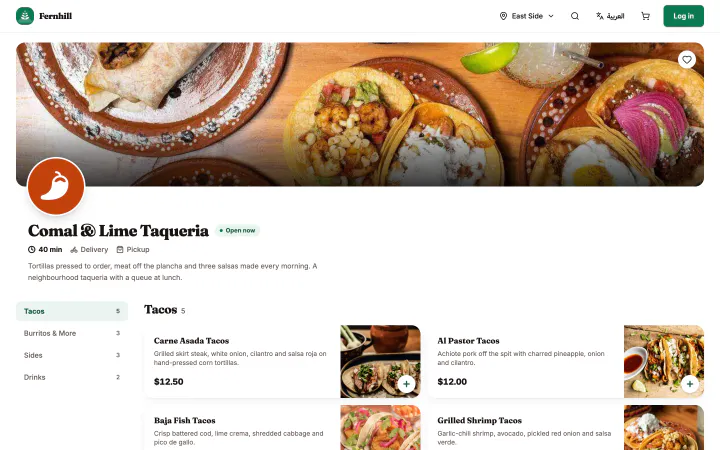
Storefront websiteA seller's page on your storefront. A cleaner lists shirts, suits and duvets the way this seller lists a menu.
-
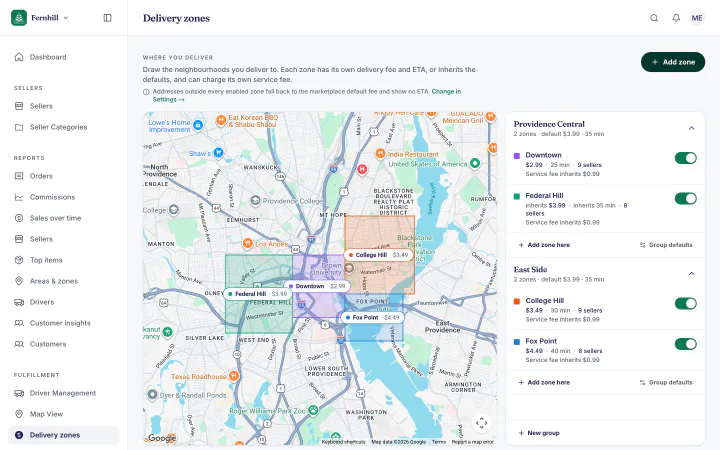
Admin portalYou draw one zone around one neighborhood and give it one fee. That is the route.
-
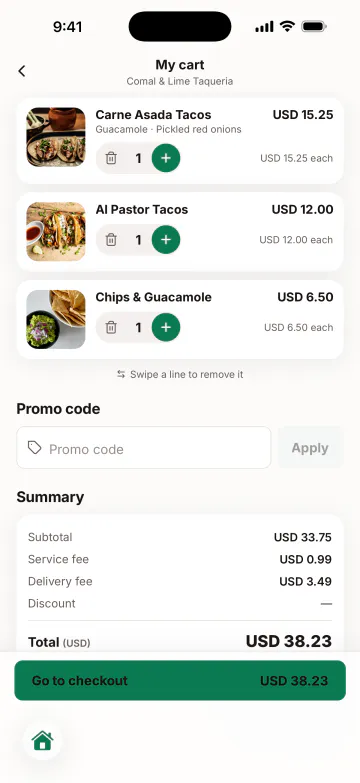
Customer appThe cart shows the items, your service fee and the delivery fee before the customer orders.
-
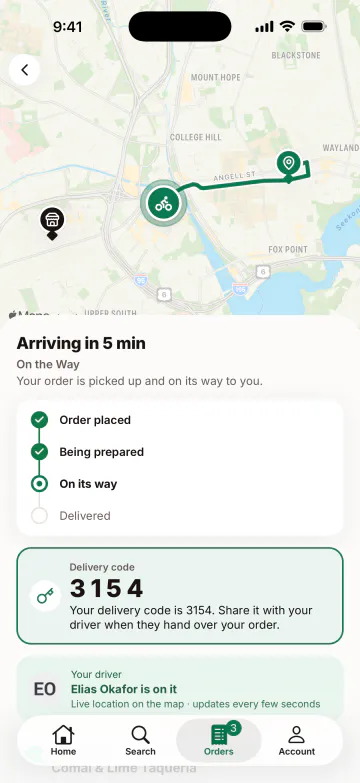
Customer appOn return day the customer follows the driver bringing the clean clothes back.
-
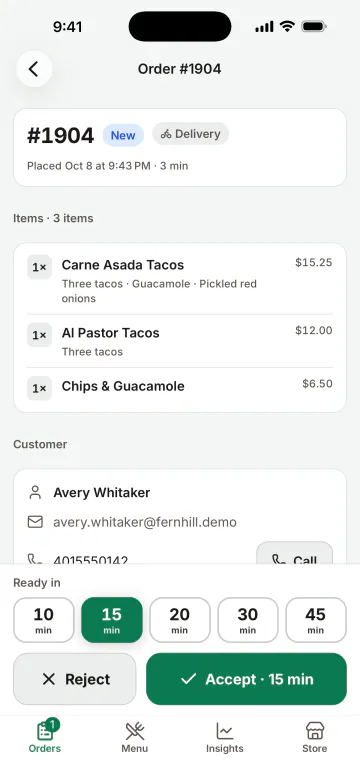
Seller appThe cleaner accepts the order and sets when it will be ready.
-
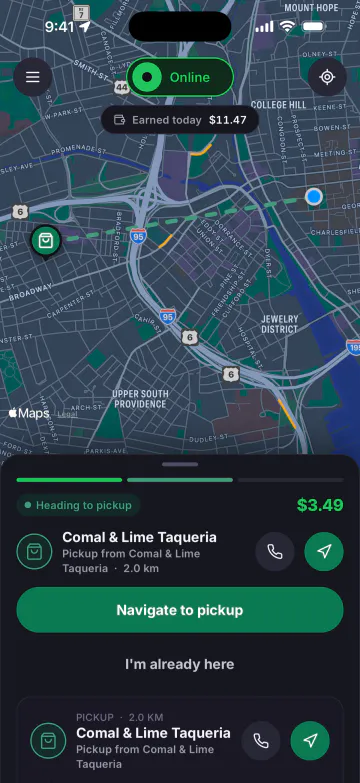
Driver appThe driver app runs the return trip: from the cleaner to the customer's door.
-
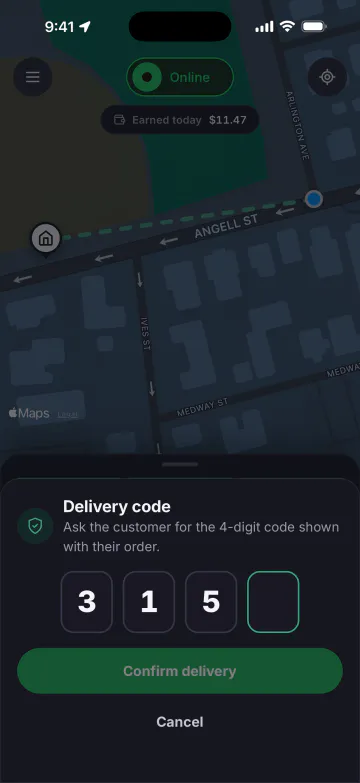
Driver appThe hand-over code confirms the clean clothes reached the right person.
Not built yet, and what version one does instead
- Collecting from the customer's door
- The driver app runs one direction: from the seller to the customer. The collection leg is not in it. Version one has customers drop off at the cleaner, or you collect on route day from your own list, and the app handles the order, the fees and the delivery back.
- Booking a pickup day and time window
- Orders are for now, not for a slot. You publish the route day, and the customer writes access details in the item's special request.
- Pricing by weight or after inspection
- Prices are fixed per listed item. A stain that needs extra work is agreed between the cleaner and the customer.
- Card payments
- Orders are paid in cash today. See “How you get paid” above for how the money moves.
What you would run it on
- The storefront website and the admin portal are in every plan. Enough to prove HangerHop with your first sellers.
- Your own customer and seller apps in the app stores come with the next plan up, along with the driver app for your first five drivers.
- Unlimited drivers come with the plan above that. On the first plan, start with pickup or let sellers hand orders over themselves.
The HangerHop launch checklist.
-
Week 1
One cleaner, one block
- Choose one neighborhood of apartment buildings.
- Find the cleaner nearest to it that cleans on site.
- Agree prices, your commission and the route days.
-
Week 2
Set up the route
- Tell us what you are building; we set up your storefront.
- List the cleaner's price list item by item.
- Draw one delivery zone and decide how collection works.
-
Week 3
Ride it yourself
- Do the first two route days in person.
- Time the round and count the stops.
- Fix the handover: bags, labels, who signs for what.
-
Week 4
Fill the round
- Flyer every building on the route with a first-order promo code.
- Ask building managers to post the route day in the lobby.
- Do not open a second neighborhood until the first round is full.
Read before you start, from Marketplace University
-
Getting Started
How to Choose the Right Marketplace to Build
Digital, physical, or service-based — how to pick the marketplace type that actually fits the opportunity in front of you.
-
Getting Started
Your First 30 Days: A Launch Checklist for a New Marketplace
From describing your idea to going live under your own brand — a practical week-by-week checklist for launching a hyper-local marketplace.
-
Customer Experience
The Psychology of Free Delivery
45% of shoppers abandon carts over shipping costs — why 'free delivery' moves purchase decisions more than the price tag itself.
Ideas next door.
-
Services
Bookings
GlowBook
Every independent barber, salon and spa in town, in one place. They cut and style. You fill the empty chairs, and take a small cut of the bookings you bring. You could earn, at 40 bookings a day $5,200 / month -
Services
Bookings
HomeFix
Vetted local plumbers, electricians, cleaners and handymen, booked in one place. They fix it. You take the bookings, vouch for the pros, and earn a cut of each job you send. You could earn, at 8 bookings a day $4,080 / month -
Services
Bookings
StudyStoop
Local tutors, one booking page. They teach. You fill their calendar, and earn a cut of the lessons you bring. You could earn, at 25 bookings a day $2,925 / month
Nobody owns HangerHop in your city. Yet.
Tell us where you would start. Our team sets up your storefront with you: your name, your sellers, your commission, live in under a week.
Opens our contact form with this idea filled in. Rather talk first? Book a demo.