Marketplace ideas Food · Pickup
TruckLine
Every food truck in town in one place. Order ahead, skip the line.
They cook at the curb. You take the orders before the customer arrives, and earn a small cut of each.
- An idea. Not a company. Yet.
Pass Our verdict on Pitch Night. Why ↓
- Orders a day
- 80
- Average order
- $14
- You earn, a month
- $2,851
An estimate from illustrative numbers (the “growing” stage), not a promise. Change every one of them ↓
The line at the taco truck is the business model's ceiling.
The Census Bureau counted about 6,000 food truck businesses in the US in 2018, nearly double the number in 2013. The food is good, the following is loyal, and the window is one person wide.
That is the gap. A truck can only take orders as fast as one person can talk, and at 12:15 the line is long enough that people keep walking. Delivery apps do not fix this: a truck does not want a courier, it wants its regulars to have ordered before they arrive.
So the pitch: they cook at the curb, you kill the line. But Pitch Night passed, and you should take that seriously. Spread 6,000 trucks across a whole country and most cities have a handful. If yours has fifty, this is a real business. If it has twelve, it is a feature inside a bigger food marketplace.
- 6,000 food truck businesses counted in the US in 2018 Source: US Census Bureau, 2020
- Nearly 2× the number counted in 2013 Source: US Census Bureau, 2020
Pass
The Pitch Night verdict
Unless your city has fifty trucks. Fewer than that, and there is not enough to list.
- Demand
- Supply
- Margin
The hard question: Does your city have enough trucks?
Who sells. Who buys.
Your sellers
Food truck owners: one or two people cooking, taking orders and taking payment through the same window. At lunch they lose customers who see the line and walk on. They cannot serve faster. They can start cooking sooner.
Where to find the first ten
- 1Count the trucks first. If your city has fewer than fifty, the verdict is pass.
- 2Go where trucks gather: the weekly food truck night, the brewery parking lot, the office park at noon.
- 3Find the organizer of the local truck rally. They have every owner's number.
- 4Pitch the truck with the longest line. They feel the problem most.
- 5Start with trucks that keep a regular spot and regular hours.
Your buyers
Office workers with thirty minutes for lunch, and regulars who already know the truck. They want the food without the wait.
How often they come back
Several times a month for lunch regulars. Low order value, high repeat, concentrated in two hours a day.
How you get paid.
-
Commission
Truck margins are tight and tickets are small. Keep the rate low: you are saving them lost sales, not bringing a new channel worth a restaurant-sized cut.
On Upzaar: one rate for the marketplace, with an override per seller. Not per category.
-
Service fee
A small flat fee for skipping the line is the natural charge here. Customers are paying for time.
On Upzaar: one flat fee per order, paid by the customer. The marketplace keeps it.
Know this before you start: orders are paid in cash today.
The customer pays the seller in person. Card payments are not live yet. That means the seller holds the money and owes you your commission and fee: the commissions report shows what each seller sold and what is yours. Plan a weekly settlement, and sign sellers who are fine with that.
What could TruckLine earn you?
Prefilled with our starting assumptions for this idea. Every number is yours to change, and the formula is at the bottom.
Estimate
You earn, per month
An estimate, not a promise$2,851
Before your costs. 11.6% of the order volume.
- Commission
- $1,971
- Service fees
- $880
Change the numbers
- Orders per day
- 80
- Average order value
- $14.00
- Your commission
- 8%
- Your service fee per order
- $0.50
- Days open per month
- 22
This is a worked example. With JavaScript on, you can change every number.
The month
- Orders
- 1,760
- Order volume (GMV)
- $24,640
- Your sellers keep
- $22,669
One order
- The customer pays
- $14.50
- The seller keeps
- $12.88
- You earn
- $1.62
What your sellers pay in commission, per month
$5,421 a month stays with your sellers. 30% is the published top-plan commission; ads, promos and refunds are extra. Sources: Uber Eats merchant pricing, Restaurant Dive on DoorDash’s plans .
Same numbers, three stages
Only the orders per day change. Pick one to load it.
How this is calculated
- Commission is taken on the order value only, not on delivery or service fees.
- The currency menu swaps the symbol. There is no exchange rate anywhere.
- Not subtracted: your Upzaar plan and its platform fee on order volume (see pricing), payment processing if you add a card gateway, marketing, and your own time. The break-even calculator takes those off.
- Promotions, refunds and canceled orders are not modeled. Real months are lumpier than this.
Where the prefilled numbers come from
- Orders per day (illustrative): Illustrative. 80 orders a day is 4 order-ahead lunches for each of 20 trucks. Pitch Night scored supply 2 out of 5: most cities do not have 20 trucks to sign.
- Average order value (illustrative): Illustrative. One lunch and a drink.
- Commission (illustrative): Illustrative. Low, because truck tickets and margins are small.
- Service fee (illustrative): Illustrative. A skip-the-line fee.
- Days open (illustrative): Weekdays only: the lunch trade.
Illustrative means we picked a plausible starting point and told you why. It is not data about a real marketplace. Replace it with what you learn from your own sellers.
What TruckLine looks like on Upzaar.
Real screens from Fernhill, our demo marketplace of local food and shops. Yours carries your name, your colors and your sellers. This idea starts with pickup, so there is no driver app here.
-
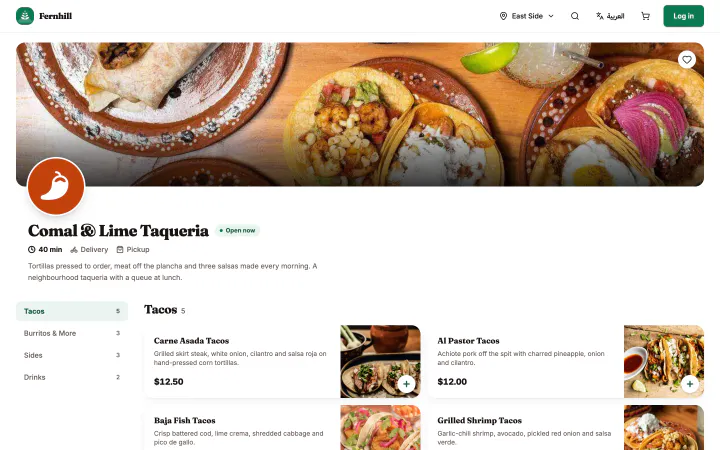
Storefront websiteA truck's page on your storefront: its menu, its photos, whether it is open now.
-
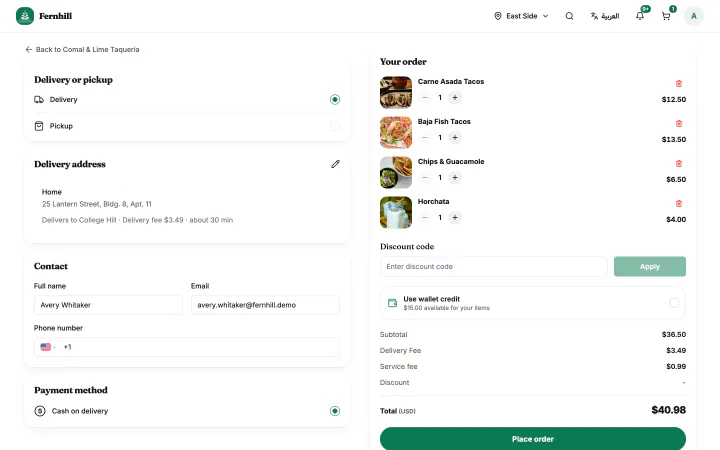
Storefront websiteCheckout offers pickup. The customer orders from their desk.
-
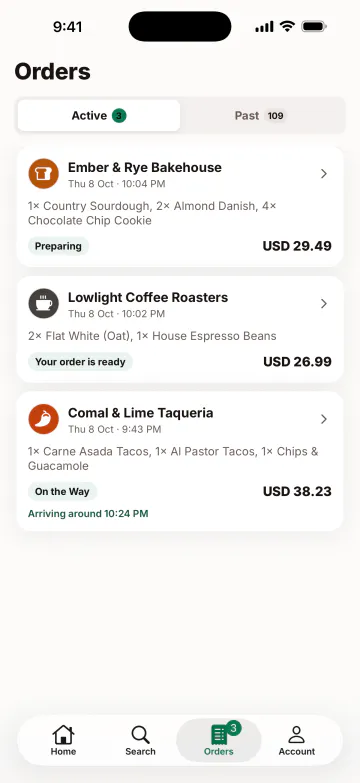
Customer appThe customer sees when the order is being made and when it is ready to collect.
-
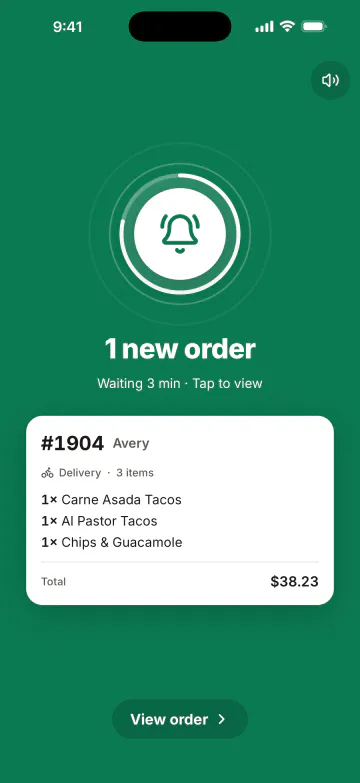
Seller appA new order takes over the truck's phone. Loud enough for a generator.
-
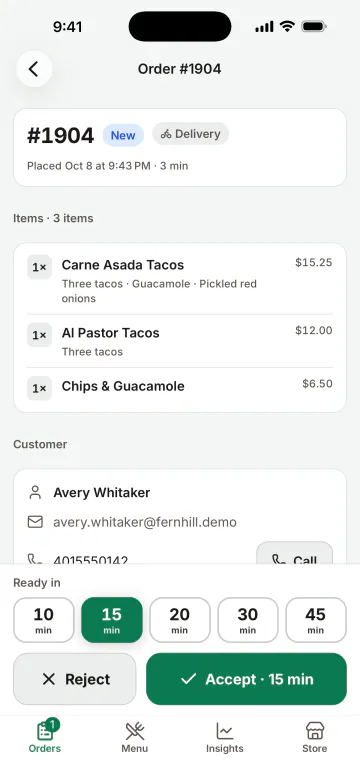
Seller appThe cook accepts with a ready-in time. That time is the product.
-
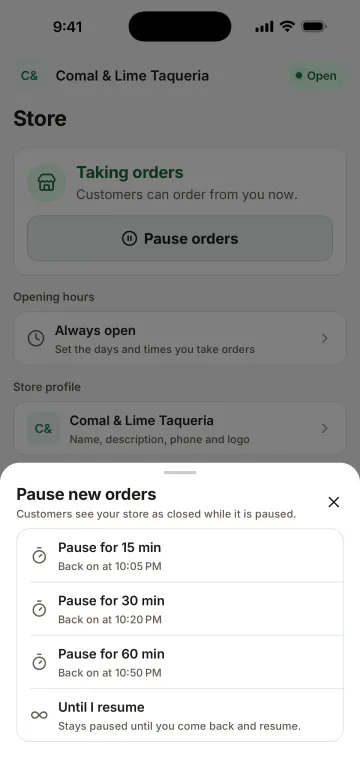
Seller appSlammed at 12:30? The truck pauses new orders for fifteen minutes.
Not built yet, and what version one does instead
- Every truck on one live map
- A seller has one fixed address; there is no map of trucks that move. Version one lists each truck at its regular pitch, and you update it in the admin portal when that changes. Trucks that park somewhere new every day are a poor fit for now.
- Ordering for a pickup time later today
- Orders are for now. The customer orders when they are ready to walk over, and the truck's ready-in time tells them when to arrive.
- Card payments
- Orders are paid in cash today. See “How you get paid” above for how the money moves.
What you would run it on
- The storefront website and the admin portal are in every plan. Enough to prove TruckLine with your first sellers.
- Your own customer and seller apps in the app stores come with the next plan up.
The TruckLine launch checklist.
-
Week 1
Count the trucks
- List every food truck that trades in your city each week.
- Under fifty? Consider a different idea. Seriously.
- Visit the biggest truck gathering and talk to ten owners.
-
Week 2
Sign the regulars
- Sign trucks with a fixed pitch and fixed hours first.
- Load short menus: the eight things they sell most.
- Tell us what you are building; we set up your storefront.
-
Week 3
Test a lunch rush
- Run one office park for one week.
- Stand at the window and time order-ahead pickups.
- Teach every truck to pause orders when the grill is full.
-
Week 4
Put it on the truck
- A QR code on every truck's window and menu board.
- A first-order promo code for the offices nearby.
- Settle with trucks and count the lunches they would have lost.
Read before you start, from Marketplace University
-
Getting Started
How to Choose the Right Marketplace to Build
Digital, physical, or service-based — how to pick the marketplace type that actually fits the opportunity in front of you.
-
Cold Outreach
Where to Find Your First Vendors (Before You Have Any Customers)
You don't need a big audience to land your first vendors — you need the right handful of places to look.
-
Getting Started
Your First 30 Days: A Launch Checklist for a New Marketplace
From describing your idea to going live under your own brand — a practical week-by-week checklist for launching a hyper-local marketplace.
Ideas next door.
-
Food
Delivery
CityEats
Your city's own delivery app: every local restaurant, one app, your commission. They cook. You run the app, charge half or less of what the giants charge, and the difference stays in your city. You could earn, at 120 orders a day $20,880 / month -
Food
Delivery
QuadPlate
A college town's local food, delivered to the dorms and run by students. They cook near campus. You own the dorms: student riders, student customers, and a commission local kitchens can afford. You could earn, at 120 orders a day $9,612 / month -
Food
Pickup
OvenDay
Five local bakeries. One pre-order. One pickup. They bake before dawn. You sell it the night before, so nothing is baked that is not already sold. You could earn, at 100 orders a day $2,160 / month
Nobody owns TruckLine in your city. Yet.
Tell us where you would start. Our team sets up your storefront with you: your name, your sellers, your commission, live in under a week.
Opens our contact form with this idea filled in. Rather talk first? Book a demo.