Marketplace ideas Grocery · Pickup
FreshTable
Your farmers' market, open the other six days.
Local growers and food makers sell one day a week. You take their orders online all week, for pickup first, and earn a commission on each one.
- An idea. Not a company. Yet.
Fund it Our verdict on Pitch Night. Why ↓
- Orders a day
- 40
- Average order
- $35
- You earn, a month
- $4,888
An estimate from illustrative numbers (the “growing” stage), not a promise. Change every one of them ↓
The market is full on Saturday. Then it packs up.
The US has more than 8,000 farmers’ markets, and USDA figures put an average one at about $11,600 in sales on a peak day. Vendors like it enough that 68% return the next year. The demand for local food is not in doubt.
But a market is a few hours on one morning. Miss it and you are back in the supermarket. The big delivery apps do not serve a grower with forty dozen eggs and no storefront: there is no menu, no kitchen, and no margin for a 30% cut.
So the play is simple. They sell one day a week. You sell the other six. Start with pickup, because fresh food is hard to deliver, and add delivery only when the orders are there.
- 8,000+ farmers' markets in the US Source: USDA Agricultural Marketing Service, Farmers Market Managers Survey
- $11,600 taken by an average market on a peak day Source: USDA Agricultural Marketing Service, market performance
- 68% of vendors come back the next year Source: USDA Agricultural Marketing Service, market performance
Fund it
The Pitch Night verdict
If you start with pickup. Fresh food is hard to deliver.
- Demand
- Supply
- Margin
The hard question: Fresh food is hard to deliver. Can you start without delivering it?
Who sells. Who buys.
Your sellers
The people behind the stalls: growers, bakers, cheese and honey makers, and the cooks who sell healthy prepared meals next to them. They already have loyal buyers and a product people pay more for. They sell it a few hours a week.
Where to find the first ten
- 1Go to the market. Every seller you need is in one parking lot on one morning.
- 2Talk to the market manager first. They know which vendors sell out and which want more sales days.
- 3Start with products that keep: eggs, honey, bread, jams, boxes of mixed veg. Leave soft fruit for later.
- 4Sign the stalls with a queue. Their regulars become your first customers.
- 5Offer to photograph each stall's ten best products yourself, that same morning.
Your buyers
The people who love the market and cannot always make it there: parents with Saturday sport, shift workers, anyone who would rather cook with local food than supermarket food if it were easy.
How often they come back
Weekly. A veg box or a regular order of eggs and bread is a habit, and habits are what make a marketplace worth owning.
How you get paid.
-
Commission
Stallholders are used to paying a stall fee to sell. A commission on sales they would not otherwise have made is an easy conversation, as long as it leaves room on a product with real costs.
On Upzaar: one rate for the marketplace, with an override per seller. Not per category.
-
Service fee
Keep it small or leave it out while you are building the habit. A weekly customer notices a fee every week.
On Upzaar: one flat fee per order, paid by the customer. The marketplace keeps it.
Know this before you start: orders are paid in cash today.
The customer pays the seller in person. Card payments are not live yet. That means the seller holds the money and owes you your commission and fee: the commissions report shows what each seller sold and what is yours. Plan a weekly settlement, and sign sellers who are fine with that.
What could FreshTable earn you?
Prefilled with our starting assumptions for this idea. Every number is yours to change, and the formula is at the bottom.
Estimate
You earn, per month
An estimate, not a promise$4,888
Before your costs. 13.4% of the order volume.
- Commission
- $4,368
- Service fees
- $520
Change the numbers
- Orders per day
- 40
- Average order value
- $35.00
- Your commission
- 12%
- Your service fee per order
- $0.50
- Days open per month
- 26
This is a worked example. With JavaScript on, you can change every number.
The month
- Orders
- 1,040
- Order volume (GMV)
- $36,400
- Your sellers keep
- $32,032
One order
- The customer pays
- $35.50
- The seller keeps
- $30.80
- You earn
- $4.70
What your sellers pay in commission, per month
$6,552 a month stays with your sellers. 30% is the published top-plan commission; ads, promos and refunds are extra. Sources: Uber Eats merchant pricing, Restaurant Dive on DoorDash’s plans .
Same numbers, three stages
Only the orders per day change. Pick one to load it.
How this is calculated
- Commission is taken on the order value only, not on delivery or service fees.
- The currency menu swaps the symbol. There is no exchange rate anywhere.
- Not subtracted: your Upzaar plan and its platform fee on order volume (see pricing), payment processing if you add a card gateway, marketing, and your own time. The break-even calculator takes those off.
- Promotions, refunds and canceled orders are not modeled. Real months are lumpier than this.
Where the prefilled numbers come from
- Orders per day (illustrative): Illustrative. 40 orders a day is about 3 a day for each of 12 stalls. For scale: USDA puts an average market's peak-day takings at about $11,600, which this stage reaches in roughly eight days online.
- Average order value (illustrative): Illustrative. A weekly box or a mixed order from two or three stalls.
- Commission (illustrative): Illustrative. Pitch Night scored the margin 2 out of 5, so this stays well below the delivery apps' 30%.
- Service fee (illustrative): Illustrative, and small: a weekly customer pays it every week.
- Days open (illustrative): Six days a week: the days the market itself is closed.
Illustrative means we picked a plausible starting point and told you why. It is not data about a real marketplace. Replace it with what you learn from your own sellers.
What FreshTable looks like on Upzaar.
Real screens from Fernhill, our demo marketplace of local food and shops. Yours carries your name, your colors and your sellers. This idea starts with pickup, so there is no driver app here.
-
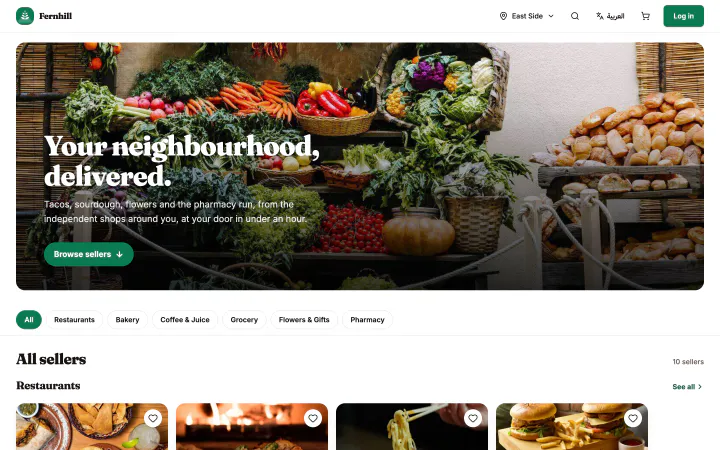
Storefront websiteYour storefront website: every stall from the market, open all week.
-
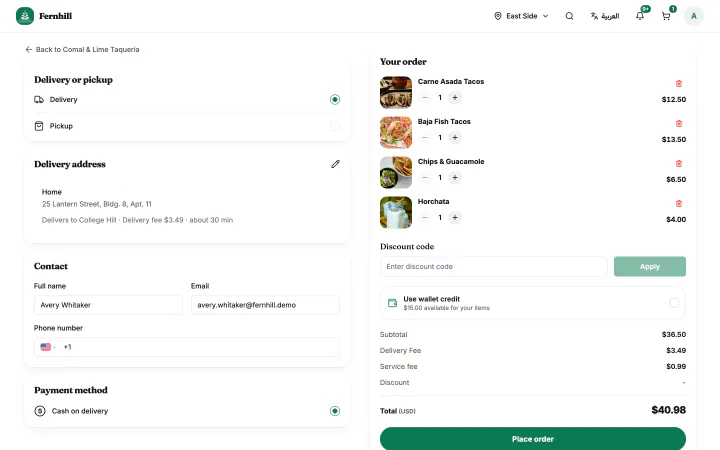
Storefront websiteCheckout offers pickup. Start there: one collection point, one or two days a week.
-
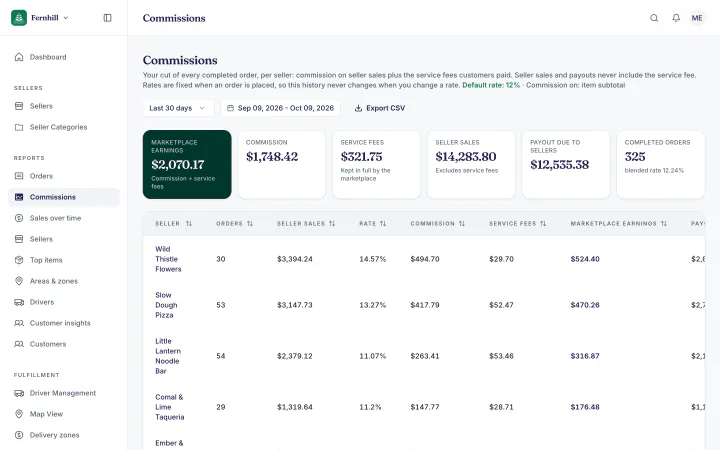
Admin portalThe commissions report: what each stall sold, your cut, and the payout due.
-
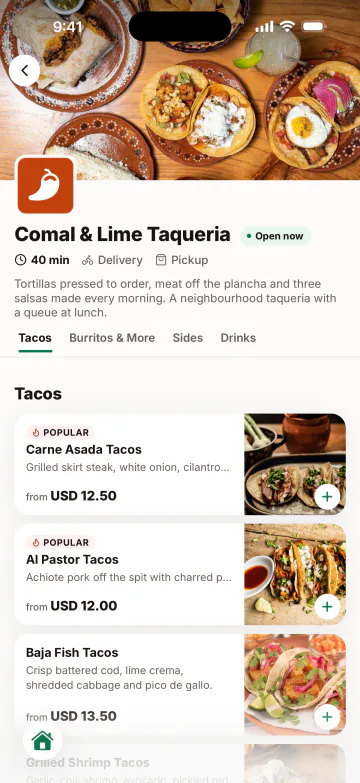
Customer appA stall's page in your app: its products, photos and prices.
-
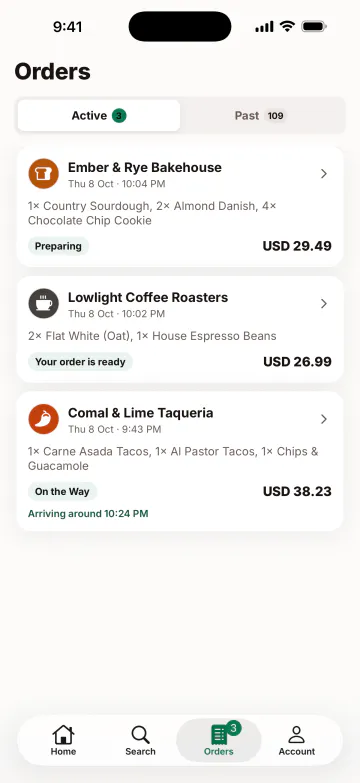
Customer appCustomers see when their order is being packed and when it is ready to collect.
-
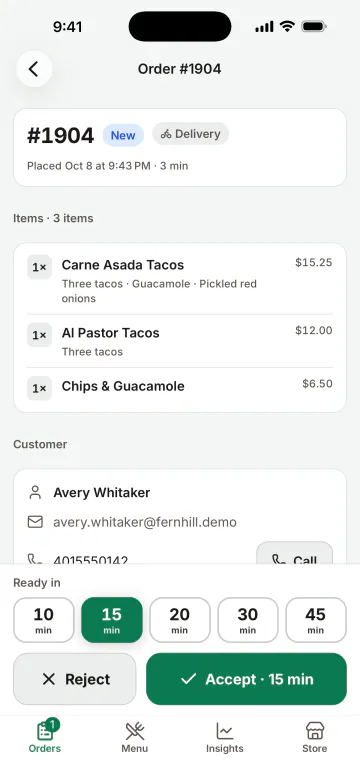
Seller appA grower accepts the order on their phone and says when it will be ready.
-
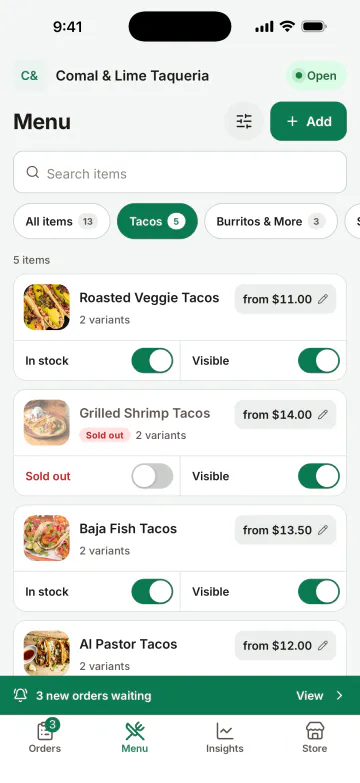
Seller appWhen the tomatoes are gone, the grower switches them off. Nobody orders what is not there.
Not built yet, and what version one does instead
- Ordering for a chosen pickup day
- Orders are placed for now, not for a date. Version one runs set pickup days: you announce them, sellers pause orders outside the window, and the pickup day goes in the item's special request.
- A shared collection point
- An order is placed with one seller and collected from that seller. For one collection point, list the market itself as a seller for mixed boxes, or run pickup from each stall's own premises.
- Cold-chain delivery
- The driver app handles deliveries, but nothing keeps food chilled for you. Add delivery only once pickup works, and only for products that travel.
- Card payments
- Orders are paid in cash today. See “How you get paid” above for how the money moves.
What you would run it on
- The storefront website and the admin portal are in every plan. Enough to prove FreshTable with your first sellers.
- Your own customer and seller apps in the app stores come with the next plan up.
The FreshTable launch checklist.
-
Week 1
Work the market
- Meet the market manager and ask who sells out.
- Shortlist fifteen stalls with products that keep.
- Tell us what you are building; we set up your storefront.
-
Week 2
Sign twelve stalls
- Agree a commission and a weekly settlement day.
- Photograph and list ten products per stall.
- Pick two pickup days and a time window.
-
Week 3
Test with regulars
- Hand a flyer with a QR code to every regular at the market.
- Run one full pickup day with twenty real orders.
- Ask each stallholder what went wrong.
-
Week 4
Make it a habit
- Launch a give-and-get referral code for regulars.
- Add the three products customers asked for most.
- Settle with every stall and share the numbers with them.
Read before you start, from Marketplace University
-
Getting Started
How to Choose the Right Marketplace to Build
Digital, physical, or service-based — how to pick the marketplace type that actually fits the opportunity in front of you.
-
Cold Outreach
Where to Find Your First Vendors (Before You Have Any Customers)
You don't need a big audience to land your first vendors — you need the right handful of places to look.
-
Referrals & Word of Mouth
How to Turn Your First Customers Into Your Referral Engine
A new marketplace's first real growth channel usually isn't ads — it's the small group of customers who already like it.
Ideas next door.
-
Grocery
Delivery
QuickCart
Corner shops deliver your neighborhood's groceries and essentials. They stock the shelves. You bring the orders, charge a small commission and a flat fee per order, and the money stays on the block. You could earn, at 80 orders a day $6,720 / month -
Retail
Pickup
Handmade Row
Your city's makers on one storefront, with same-day pickup. They make it. You sell it down the street, as gifts people need today, for a commission they can live with. You could earn, at 15 orders a day $2,430 / month -
Food
Pickup
TruckLine
Every food truck in town in one place. Order ahead, skip the line. They cook at the curb. You take the orders before the customer arrives, and earn a small cut of each. You could earn, at 80 orders a day $2,851 / month
Nobody owns FreshTable in your city. Yet.
Tell us where you would start. Our team sets up your storefront with you: your name, your sellers, your commission, live in under a week.
Opens our contact form with this idea filled in. Rather talk first? Book a demo.