Marketplace ideas Retail · Pickup
Handmade Row
Your city's makers on one storefront, with same-day pickup.
They make it. You sell it down the street, as gifts people need today, for a commission they can live with.
- An idea. Not a company. Yet.
Fix one thing Our verdict on Pitch Night. Why ↓
- Orders a day
- 15
- Average order
- $45
- You earn, a month
- $2,430
An estimate from illustrative numbers (the “growing” stage), not a promise. Change every one of them ↓
Makers sell to the world and pay for the privilege.
In 2022 Etsy raised its transaction fee from 5% to 6.5%: a 30% increase, announced once, applied to every seller. Thousands of sellers pulled their listings in protest, and some went on to start a co-operative marketplace of their own.
The lesson is not that makers should leave the global platforms. It is that they have no local one. A potter in your city can reach a buyer in another country and cannot reach the person five streets away who needs a housewarming present by six o’clock.
So here is the pitch. They make it. You sell it down the street. The fix from Pitch Night is the business model: do not run a craft marketplace, run your city’s gift shop. Handmade is the supply. Gifts are the demand.
- 5% → 6.5% Etsy's transaction fee from April 2022: a 30% rise, announced once, for every seller Source: NPR, 2022
- Thousands of Etsy sellers pulled their listings in protest; some went on to start their own co-op marketplace Source: Co-op News, 2022
Fix one thing
The Pitch Night verdict
Sell gifts, not crafts. Nobody buys handmade every week; everybody needs a present.
- Demand
- Supply
- Margin
The hard question: Who buys handmade every week?
Who sells. Who buys.
Your sellers
Potters, jewelers, candle makers, printmakers, leather workers. They sell at weekend markets and on global platforms where they are one of millions. Most have no shop of their own and no way to reach the person five streets away who needs a gift tonight.
Where to find the first ten
- 1Go to the next craft fair or makers' market with a notebook. That is your whole supply side in one hall.
- 2Look at who your city's independent gift shops stock. Those makers already sell locally.
- 3Search Instagram for your city's name plus handmade, ceramics, jewelry.
- 4Pick makers with stock on the shelf, not made-to-order with a three-week wait.
- 5Sign a spread: something under $20, something around $50, something special. Gifts need price points.
Your buyers
People who need a present: a birthday on Saturday, a housewarming, a thank-you. They want something better than a gift card and they want it today. They are not browsing crafts. They are solving a problem.
How often they come back
A few times a year each, clustered around birthdays and holidays. That is why the fix matters: you need many occasional buyers, and gifting gives every one of them a reason.
How you get paid.
-
Commission
Handmade has room in the price, and makers are used to paying marketplace fees and to shops taking a far bigger wholesale cut. A fair local rate is an easy yes.
On Upzaar: one rate for the marketplace, with an override per seller. Not per category.
-
Service fee
Skip it at the start. A gift buyer comparing you with a shop should see the price on the tag.
On Upzaar: one flat fee per order, paid by the customer. The marketplace keeps it.
Know this before you start: orders are paid in cash today.
The customer pays the seller in person. Card payments are not live yet. That means the seller holds the money and owes you your commission and fee: the commissions report shows what each seller sold and what is yours. Plan a weekly settlement, and sign sellers who are fine with that.
What could Handmade Row earn you?
Prefilled with our starting assumptions for this idea. Every number is yours to change, and the formula is at the bottom.
Estimate
You earn, per month
An estimate, not a promise$2,430
Before your costs. 12.0% of the order volume.
- Commission
- $2,430
- Service fees
- $0
Change the numbers
- Orders per day
- 15
- Average order value
- $45.00
- Your commission
- 12%
- Your service fee per order
- $0.00
- Days open per month
- 30
This is a worked example. With JavaScript on, you can change every number.
The month
- Orders
- 450
- Order volume (GMV)
- $20,250
- Your sellers keep
- $17,820
One order
- The customer pays
- $45.00
- The seller keeps
- $39.60
- You earn
- $5.40
What your sellers pay in commission, per month
$3,645 a month stays with your sellers. 30% is the published top-plan commission; ads, promos and refunds are extra. Sources: Uber Eats merchant pricing, Restaurant Dive on DoorDash’s plans .
Same numbers, three stages
Only the orders per day change. Pick one to load it.
How this is calculated
- Commission is taken on the order value only, not on delivery or service fees.
- The currency menu swaps the symbol. There is no exchange rate anywhere.
- Not subtracted: your Upzaar plan and its platform fee on order volume (see pricing), payment processing if you add a card gateway, marketing, and your own time. The break-even calculator takes those off.
- Promotions, refunds and canceled orders are not modeled. Real months are lumpier than this.
Where the prefilled numbers come from
- Orders per day (illustrative): Illustrative, and deliberately small: Pitch Night scored demand 3 out of 5. 15 orders a day is fewer than one a day per maker across 25 makers.
- Average order value (illustrative): Illustrative. One gift, or a gift and a card.
- Commission (illustrative): Illustrative. For reference, Etsy's transaction fee has been 6.5% since April 2022 (NPR).
- Service fee (illustrative): None, so the price on the tag is the price.
- Days open (illustrative): The storefront is open every day; makers accept when they can.
Illustrative means we picked a plausible starting point and told you why. It is not data about a real marketplace. Replace it with what you learn from your own sellers.
What Handmade Row looks like on Upzaar.
Real screens from Fernhill, our demo marketplace of local food and shops. Yours carries your name, your colors and your sellers. This idea starts with pickup, so there is no driver app here.
-
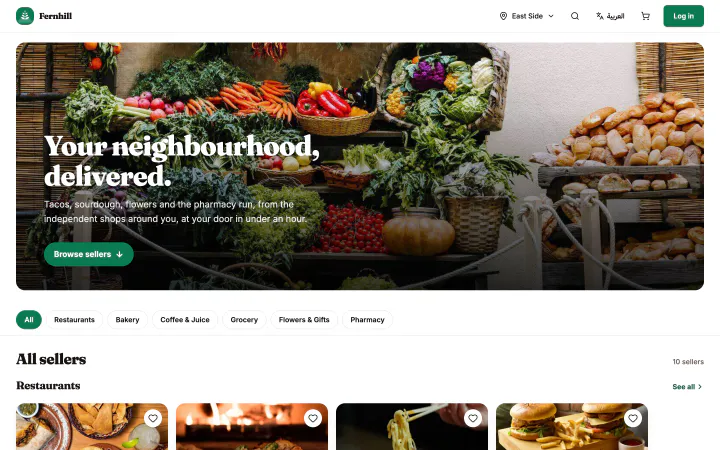
Storefront websiteYour storefront website: the city's makers in one place, with your own categories. Make them occasions, not crafts.
-
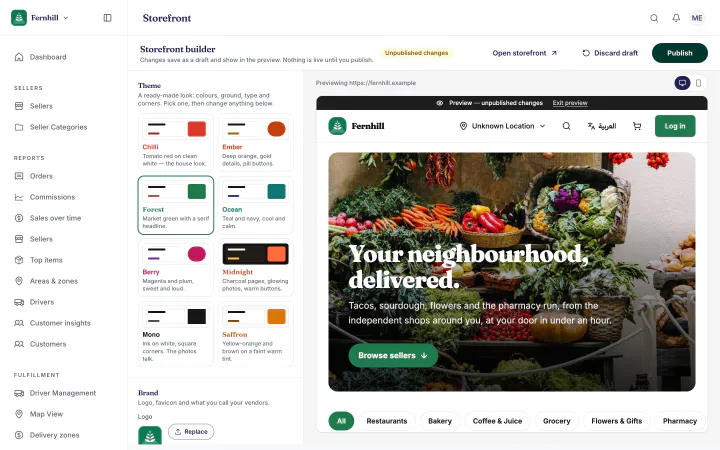
Admin portalYou style the storefront yourself: colors, fonts, the hero. A gift shop should look like one.
-
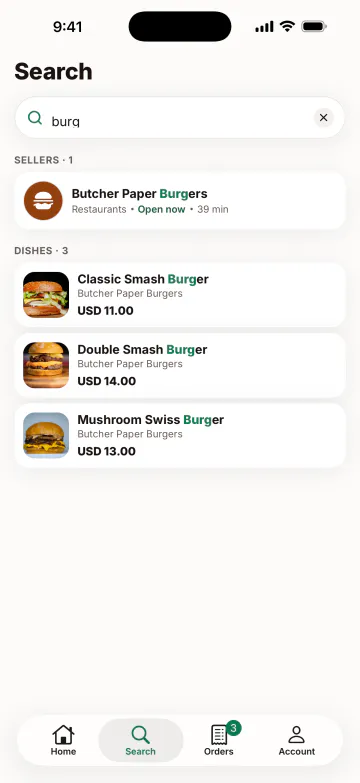
Customer appA buyer searches for what they need and finds the maker who has it.
-
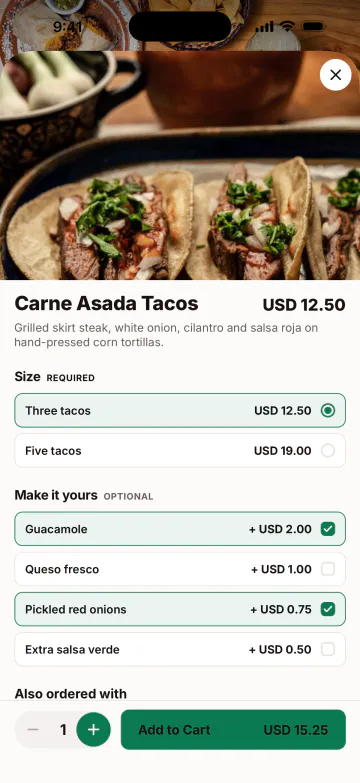
Customer appAn item with choices and paid add-ons: a size, a color, gift wrapping.
-
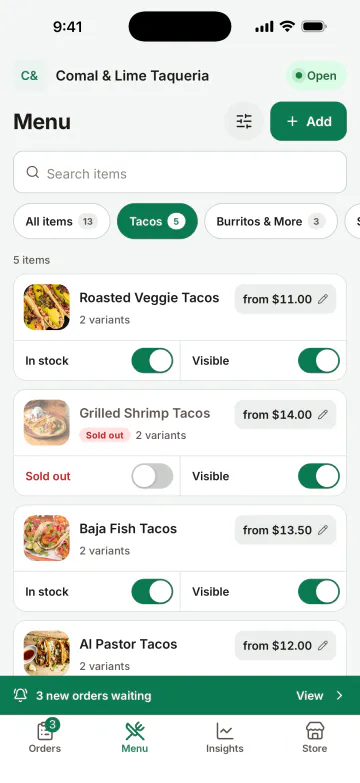
Seller appA maker marks a one-off piece sold out the moment it sells at a market.
-
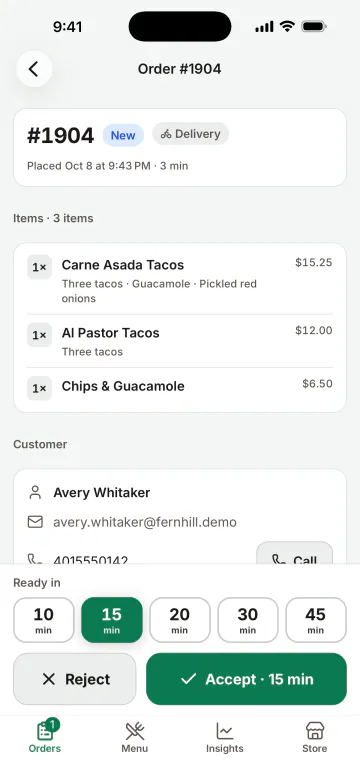
Seller appThe maker accepts the order and says when it can be collected.
Not built yet, and what version one does instead
- Shipping to other cities
- Upzaar is built for one city: pickup and local delivery, no parcel carriers or shipping labels. That is the point of this idea. Makers keep their global shop for the rest.
- A gift message and gift wrap at checkout
- There is no gift option. Version one offers gift wrap as a paid add-on on each item, and the buyer writes the message in the item's special request.
- Card payments
- Orders are paid in cash today. See “How you get paid” above for how the money moves.
What you would run it on
- The storefront website and the admin portal are in every plan. Enough to prove Handmade Row with your first sellers.
- Your own customer and seller apps in the app stores come with the next plan up.
The Handmade Row launch checklist.
-
Week 1
Walk the fair
- Visit one makers' market and collect thirty names.
- Decide your gift categories: for her, for him, new home, under $25.
- Tell us what you are building; we set up your storefront.
-
Week 2
Sign twenty makers
- Agree a commission and a pickup arrangement with each.
- List ten in-stock pieces per maker, with good photos.
- Add gift wrap as a paid add-on.
-
Week 3
Find the occasions
- Build a page for the next holiday or local event.
- Ask makers to post the storefront to their followers.
- Place ten test orders and collect them yourself.
-
Week 4
Sell the first gifts
- Run a first-order promo code through the makers' own accounts.
- Put a QR code on every maker's market stall.
- Settle with makers and ask what sold.
Read before you start, from Marketplace University
-
Getting Started
How to Choose the Right Marketplace to Build
Digital, physical, or service-based — how to pick the marketplace type that actually fits the opportunity in front of you.
-
Cold Outreach
Where to Find Your First Vendors (Before You Have Any Customers)
You don't need a big audience to land your first vendors — you need the right handful of places to look.
-
Referrals & Word of Mouth
How to Turn Your First Customers Into Your Referral Engine
A new marketplace's first real growth channel usually isn't ads — it's the small group of customers who already like it.
Ideas next door.
-
Retail
Delivery
PetalBlock
Your city's real florists, on one storefront. They arrange it. You send the orders, straight to a real local shop, and keep a commission the shop agreed to. You could earn, at 20 orders a day $7,050 / month -
Retail
Delivery
LeashLocal
Independent pet shops, delivered. The heavy bag arrives every month. They stock the food. You bring it to the door on repeat, and earn on an order that comes back every month. You could earn, at 25 orders a day $4,875 / month -
Retail
Pickup
SecondLap
Every thrift and consignment shop in town, in one feed. They sort it. You put the best of it online for local pickup, and earn a commission on each piece. You could earn, at 15 orders a day $1,512 / month
Nobody owns Handmade Row in your city. Yet.
Tell us where you would start. Our team sets up your storefront with you: your name, your sellers, your commission, live in under a week.
Opens our contact form with this idea filled in. Rather talk first? Book a demo.