Marketplace ideas Retail · Delivery
PetalBlock
Your city's real florists, on one storefront.
They arrange it. You send the orders, straight to a real local shop, and keep a commission the shop agreed to.
- An idea. Not a company. Yet.
Fund it Our verdict on Pitch Night. Why ↓
- Orders a day
- 20
- Average order
- $65
- You earn, a month
- $7,050
An estimate from illustrative numbers (the “growing” stage), not a promise. Change every one of them ↓
Flowers ordered online. Which shop actually makes them?
The US has nearly 12,000 retail florist shops, and Americans spent $78 billion on flowers, seeds and plants in 2025. People send flowers. That is settled.
What is not settled is who makes them. Order online and you often cannot tell which shop will fill the order, or whether the bouquet will look like the picture. The florist on your street, with a cooler full of flowers and a van, is nowhere in that search.
So here is the pitch. They arrange it. You send the orders. The verdict was fund it, on one condition: every order reaches a real local shop, and the customer can see which one. That is not a detail. It is the reason to exist.
- 12,000 retail florist shops in the US, nearly Source: Society of American Florists, 2024
- $78B spent by Americans on flowers, seeds and plants Source: Society of American Florists, 2025
Fund it
The Pitch Night verdict
If every order reaches a real local shop.
- Demand
- Supply
- Margin
The hard question: Why not just call the shop?
Who sells. Who buys.
Your sellers
Independent florists with a real shop, a cooler and their own style. They already deliver around town in their own van and take orders by phone. What they lack is a place online where a customer can compare the city's florists and order from the one they like.
Where to find the first ten
- 1List every florist in the city on a map. In most cities that is a short list, and you can visit them all in a week.
- 2Start with the ones whose own website has no checkout.
- 3Go in on a Tuesday, never the week of Valentine's or Mother's Day.
- 4Ask to photograph five arrangements they make every week.
- 5Promise the thing they care about: the customer sees their name and gets their flowers.
Your buyers
People sending flowers: birthdays, sympathy, apologies, anniversaries. Often they are ordering from work for delivery today, and they want to know a real shop nearby will make what they saw in the photo.
How often they come back
A few times a year per person, with huge peaks around Valentine's Day and Mother's Day. Plan your launch well before a peak, never during one.
How you get paid.
-
Commission
Flower orders are a decent size and florists already pay to receive orders from networks. A rate they can see and agree to is your selling point.
On Upzaar: one rate for the marketplace, with an override per seller. Not per category.
-
Service fee
A small flat fee per order is normal for flower delivery.
On Upzaar: one flat fee per order, paid by the customer. The marketplace keeps it.
-
Delivery
Florists often deliver themselves. Use your own riders only where a shop wants you to, and price the zone so the rider is covered.
On Upzaar: you set a delivery fee per zone you draw. Today the driver’s earning for a job is that fee, so the calculator starts your delivery margin at zero.
Know this before you start: orders are paid in cash today.
The customer pays the driver at the door. Card payments are not live yet. The driver app tracks the cash each driver holds, you record their deposits, and the commissions report shows what each seller sold, your cut and the payout due. Plan a weekly settlement with sellers and drivers.
What could PetalBlock earn you?
Prefilled with our starting assumptions for this idea. Every number is yours to change, and the formula is at the bottom.
Estimate
You earn, per month
An estimate, not a promise$7,050
Before your costs. 18.1% of the order volume.
- Commission
- $5,850
- Service fees
- $1,200
- Delivery margin
- $0
Change the numbers
- Orders per day
- 20
- Average order value
- $65.00
- Your commission
- 15%
- Your service fee per order
- $2.00
- Delivery fee the customer pays
- $8.00
- What you pay the driver
- $8.00
- Days open per month
- 30
This is a worked example. With JavaScript on, you can change every number.
The month
- Orders
- 600
- Order volume (GMV)
- $39,000
- Your sellers keep
- $33,150
- Your drivers are paid
- $4,800
One order
- The customer pays
- $75.00
- The seller keeps
- $55.25
- You earn
- $11.75
What your sellers pay in commission, per month
$5,850 a month stays with your sellers. 30% is the published top-plan commission; ads, promos and refunds are extra. Sources: Uber Eats merchant pricing, Restaurant Dive on DoorDash’s plans .
Same numbers, three stages
Only the orders per day change. Pick one to load it.
How this is calculated
- Commission is taken on the order value only, not on delivery or service fees.
- The currency menu swaps the symbol. There is no exchange rate anywhere.
- Not subtracted: your Upzaar plan and its platform fee on order volume (see pricing), payment processing if you add a card gateway, marketing, and your own time. The break-even calculator takes those off.
- Promotions, refunds and canceled orders are not modeled. Real months are lumpier than this.
Where the prefilled numbers come from
- Orders per day (illustrative): Illustrative. 20 orders a day is 2 a day for each of 10 florists. Peaks around Valentine's and Mother's Day will be far above this, and quiet weeks below.
- Average order value (illustrative): Illustrative. A mid-size arrangement.
- Commission (illustrative): Illustrative. Half of the 30% top plans of the delivery apps.
- Service fee (illustrative): Illustrative. A flat fee per order.
- Delivery (illustrative): Illustrative. The fee and the driver's pay start equal: on Upzaar today the driver's earning for a job is the delivery fee the customer paid.
- Days open (illustrative): Flowers are sent every day.
Illustrative means we picked a plausible starting point and told you why. It is not data about a real marketplace. Replace it with what you learn from your own sellers.
What PetalBlock looks like on Upzaar.
Real screens from Fernhill, our demo marketplace of local food and shops. Yours carries your name, your colors and your sellers.
-
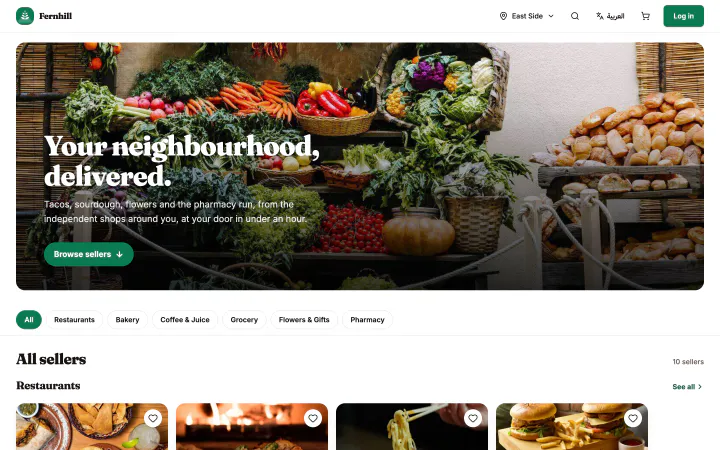
Storefront websiteYour storefront website: every florist in the city, each under its own name.
-
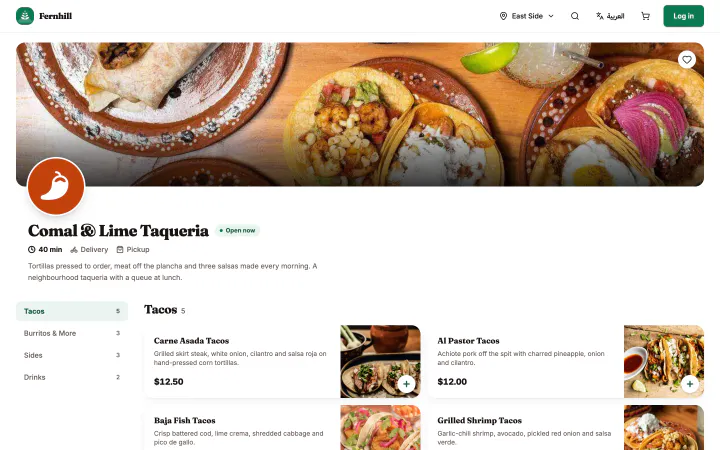
Storefront websiteA shop's own page. The customer knows exactly who is making the bouquet.
-
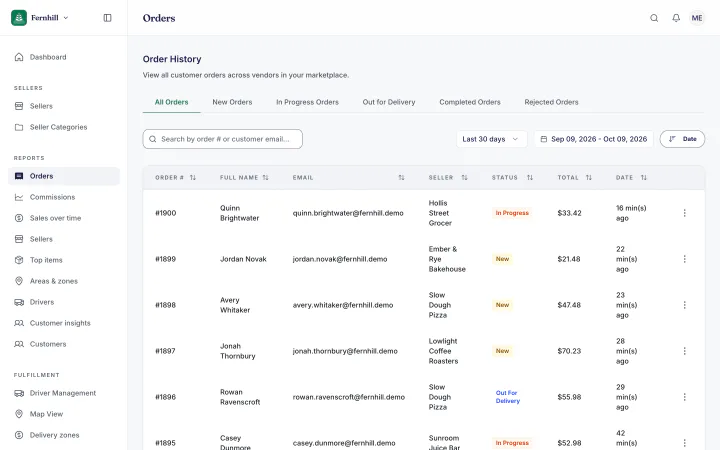
Admin portalYou see every order across every shop, and step in when one is stuck.
-
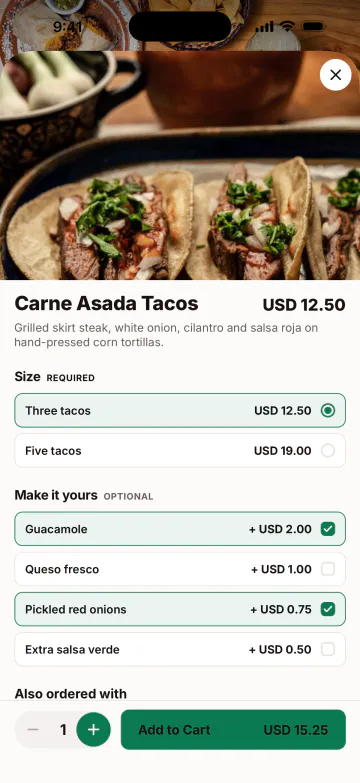
Customer appAn arrangement with a required size and paid add-ons: a vase, a card, chocolates.
-
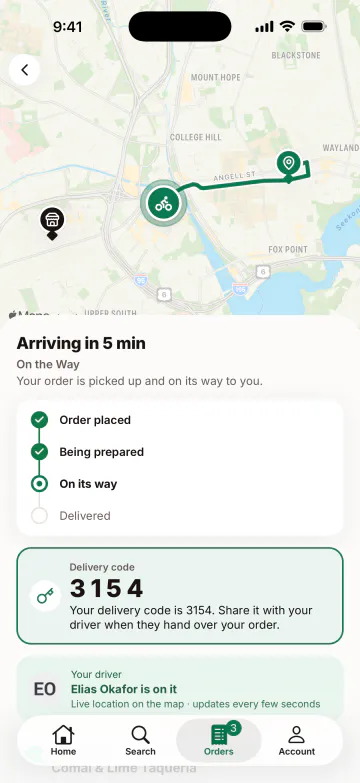
Customer appThe sender follows the delivery to the door.
-
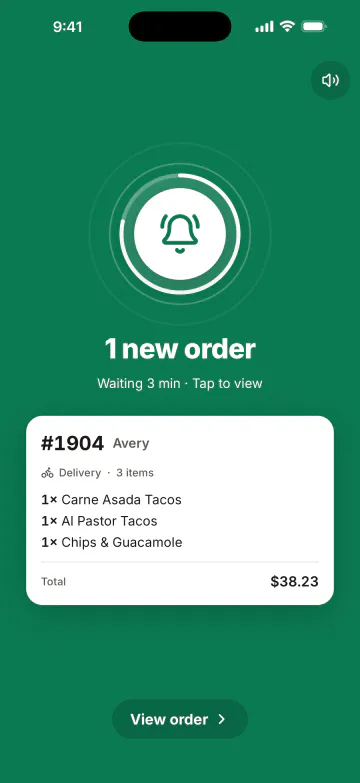
Seller appA new order rings on the florist's phone at the workbench.
-
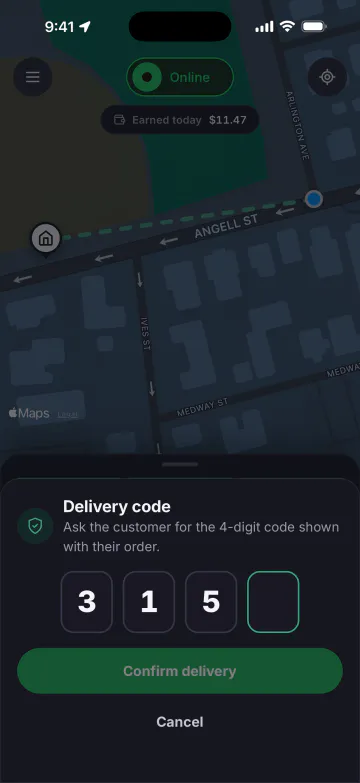
Driver appA hand-over code confirms the bouquet reached the right person.
Not built yet, and what version one does instead
- Choosing a delivery date
- Orders are for now, not for a chosen day. For flowers that matters. Version one asks the sender to put the date in the item's special request, and the florist accepts when they can make it. Fine for same-day, clumsy for Friday week.
- A card message field
- There is no gift message field. The sender writes the card in the item's special request, up to 500 characters.
- Florists delivering in their own van
- Delivery orders go to the drivers on your marketplace, through the driver app. There is no setting for a seller to deliver their own orders, so a florist's van driver joins as one of your drivers, or you start that shop on pickup.
- Card payments
- Orders are paid in cash today. See “How you get paid” above for how the money moves.
What you would run it on
- The storefront website and the admin portal are in every plan. Enough to prove PetalBlock with your first sellers.
- Your own customer and seller apps in the app stores come with the next plan up, along with the driver app for your first five drivers.
- Unlimited drivers come with the plan above that. On the first plan, start with pickup or let sellers hand orders over themselves.
The PetalBlock launch checklist.
-
Week 1
Map the florists
- List every independent florist in the city.
- Visit each one and ask how they get online orders now.
- Tell us what you are building; we set up your storefront.
-
Week 2
Sign ten shops
- Agree a commission and who delivers.
- List five arrangements per shop, with sizes and add-ons.
- Draw delivery zones around each shop.
-
Week 3
Send test bouquets
- Send ten real orders to friends across town.
- Check each one against its photo.
- Time every delivery, order to door.
-
Week 4
Launch before a peak
- Open at least three weeks before the next big flower day.
- Run a first-order promo code with local offices.
- Settle with shops and ask what they would change.
Read before you start, from Marketplace University
-
Cold Outreach
Where to Find Your First Vendors (Before You Have Any Customers)
You don't need a big audience to land your first vendors — you need the right handful of places to look.
-
Commissions & Pricing
How to Set Your Marketplace Commission Rate
Too high and vendors won't join. Too low and the business doesn't work. Here's how to actually land on a number.
-
Getting Started
Your First 30 Days: A Launch Checklist for a New Marketplace
From describing your idea to going live under your own brand — a practical week-by-week checklist for launching a hyper-local marketplace.
Ideas next door.
-
Retail
Pickup
Handmade Row
Your city's makers on one storefront, with same-day pickup. They make it. You sell it down the street, as gifts people need today, for a commission they can live with. You could earn, at 15 orders a day $2,430 / month -
Retail
Delivery
LeashLocal
Independent pet shops, delivered. The heavy bag arrives every month. They stock the food. You bring it to the door on repeat, and earn on an order that comes back every month. You could earn, at 25 orders a day $4,875 / month -
Retail
Pickup
SecondLap
Every thrift and consignment shop in town, in one feed. They sort it. You put the best of it online for local pickup, and earn a commission on each piece. You could earn, at 15 orders a day $1,512 / month
Nobody owns PetalBlock in your city. Yet.
Tell us where you would start. Our team sets up your storefront with you: your name, your sellers, your commission, live in under a week.
Opens our contact form with this idea filled in. Rather talk first? Book a demo.